Search This Blog

Showing posts with label 7000. Show all posts

BLP 7030 (NR)

Sidney Bechet - Olympia Concert Paris - Volume 2

Released - 

Recording and Session Information

"L'Olympia", Paris, France, December 8, 1954
Pierre Dervaux, Gilles Thibaut, trumpet; Benny Vasseur, trombone; Claude Luter, clarinet; Sidney Bechet, soprano sax; Yannick St. Gerry, piano; Claude Phillippe, banjo; Roland Bianchini, bass; Marcel Blanche, drums.

Montmartre Boogie Woogie
When The Saints Go Marching In
Muskrat Ramble
Sobbin' And Cryin' Blues
On The Sunny Side Of The Street

Track Listing

Side One
TitleAuthorRecording Date
Montmartre BoogieBechetDecember 8 1954
Muskrat RambleOryDecember 8 1954
On The Sunny Side Of The StreetFields-McHughDecember 8 1954
Side Two
Sobbin' And Cryin'BechetDecember 8 1954
When The SaintsTraditionalDecember 8 1954

Liner Notes

SIDNEY BECHET, soprano sax; CLAUDE LUTER, clarinet; PIERRE DERVAUX, GIL THIBAUT, trumpets; BENNY VASSEUR, trombone; YANICK ST. GERY, piano; CLAUDE PHILIPPE, banjo; ROLAND BIANCHINI, bass; MARCEL BLANCHE, drums.

THERE'S AN EXCITEMENT on these sides that isn't explained by just the music alone. And there's lots of music—some of the very best Bechet you've ever heard.

For there's no doubt about it — Bechet is King of Paris, and in spite of his white hair, he's the youngest and happiest king they ever had! His palace is the Olympia Hall, his audience drawn from Paris and the surrounding country. And his court, for this appearance, the well-known Claude Luter band. What happens when they all get together is right here — and it makes you want to join up. For its music as happy and sensitive as any you'll ever hear. And there's something about it that makes you proud.

You can hear it echoed in the throat of the crowd — not the wild kind of yelling that's become fashionable at jazz concerts, but the kind of sound a crowd makes when it has love in it — and pure joy. And you can hear it in the whole Luter band, chording behind those soaring solos, each chord a feeling, handing it on to Bechet—saying here it is — and the chord is accepted and held close, and brought forth again — lyric and climbing. For there's more than just the music here. There's a kind of love that gets across with each tune—the sort of thing that makes you feel the presence of a man as well as his music.

And Bechet is quite a man. He had his beginnings way back near the time jazz was born, and he grew up with it. He played with Keppard and Oliver in New Orleans—he was there when it happened and he was a part of it. But, somehow, the spark in him is brighter than it ever was. The years have only made him greater.

Listen to him, for example, on Sunny Side of the Street. There's something here time can't touch, and the crowd knows it. Chorus after chorus, lyric, inventive, the way it must have been on the night jazz was born. Any ordinary jazzman would be satisfied with one performance like this in a lifetime — for Bechet it is only a beginning. For on Temperamental, an original, you will hear one of the finest examples of truly creative improvisation ever recorded. It starts with a simple statement of the melody — and then Bechet, never one to rush things; starts to build. Each chorus could be the top, but it isn't, until finally the tune climaxes with a lyric passage that should be a classic. And if this isn't proof enough of the greatness of the man, he follows it with another original called Sobbin' and Cryin', and does the same thing all over again on an entirely different melody and tempo. As-Tu Le Cafard (Have you got the Blues?) is the sort of tune that, were you an American in Paris, you'd get so homesick you'd take the next boat back. For Bechet has an uncanny power to evoke a mood, and he can do it superbly.

And the French can't resist. They clap with him on Halle Halleluiah because it's impossible for them to keep still. What ever jazz is, the French recognize it when they hear it. For it's in the blood today, as it was when they helped bring it to New Orleans so many years ago. And you'll know, as in the wonderful Riverboat Shuffle, that Bechet has finally brought the gift back home to them again.

It's a gift echoed in Claude Luter's clarinet—soft, sensitive, feeling its way behind Bechet, phrasing bits of the melody for Bechet to shape and form as only he can. It's echoed in Yanick St. Gery's piano, with a left hand that has a James P. kick to it, and in Marcel Blanche's drums. For the Luter band, already a fixture in Paris, lets the great man swing the compass for them, and then strides with him.

And how much of the pure fun of jazz is here too—the wild Muskrat Ramble, played with such Gallic enthusiasm you'd think that the muskrat was the national animal of France — the really hot trumpet solos of Pierre Dervaux and Gil Thibaut making up for the fact that they weren't born forty years ago in New Orleans by frantically trying to invoke Louis right out of the French sky! I suspect Bechet had a smile on his face as he stood aside and listened, but it must have been a smile which acknowledged the tribute and the pleasure.

This pleasure, which is so much a part of his playing, is also part of his secret. For Bechet has never grown old. He's still playing with the same fire as on the day he blew his first chorus. And on this night he makes the echoes of New Orleans, and Chicago, and New York become the echoes of Paris as well.

Think of him as he lives there today, sitting quietly at the sidewalk cafes, a sort of King with his court of passing admirers—a white haired king, talking his fluent, melodious French, with his rich soft smile that's full of wisdom, and eyes that are full of fun. Jelly Roll said of him that he plays more music than you could ever put on paper. But that's only half the story. When you hear him play here you'll know the other half — that Bechet is greater than any chorus he might ever take — a truly warm human being who's managed to bridge not only two continents, but an era. He sings of many things—of New Orleans and the Paris he loves so well. But above all, he sings about the things that stir in each of us, and he sings of them as a poet.

Which is why they're cheering for him on these sides. And, if you listen, most probably you will join them.

—ROBERT S. GREENE

On the Cover: Sidney Bechet at the Olympia.
Photo by FRANCIS WOLFF
Design by JOHN HERMANSADER


BLP 7029

Sidney Bechet - Olympia Concert, Paris - Volume 1

Released - 1955

Recording and Session Information

"L'Olympia", Paris, France, December 8, 1954
Pierre Dervaux, Gilles Thibaut, trumpet; Benny Vasseur, trombone; Claude Luter, clarinet; Sidney Bechet, soprano sax; Yannick St. Gerry, piano; Claude Phillippe, banjo; Roland Bianchini, bass; Marcel Blanche, drums.

Buddy Bolden Stomp
Temperamental
Have You Got The Blues
Riverboat Shuffle
Halle Hallelujah

Track Listing

Side One
TitleAuthorRecording Date
Buddy Bolden StompBechetDecember 8 1954
TemperamentalBechetDecember 8 1954
Riverboat ShuffleCarmichael-MillsDecember 8 1954
Side Two
Halle HallelujahBechetDecember 8 1954
As-Tu Le CafardBechetDecember 8 1954

Liner Notes

SIDNEY BECHET, soprano sax; CLAUDE LUTER, clarinet; PIERRE DERVAUX, GIL THIBAUT, trumpets; BENNY VASSEUR, trombone; YANICK ST. GERY, piano; CLAUDE PHILIPPE, banjo; ROLAND BIANCHINI, bass; MARCEL BLANCHE, drums.

THERE'S AN EXCITEMENT on these sides that isn't explained by just the music alone. And there's lots of music—some of the very best Bechet you've ever heard.

For there's no doubt about it — Bechet is King of Paris, and in spite of his white hair, he's the youngest and happiest king they ever had! His palace is the Olympia Hall, his audience drawn from Paris and the surrounding country. And his court, for this appearance, the well-known Claude Luter band. What happens when they all get together is right here — and it makes you want to join up. For its music as happy and sensitive as any you'll ever hear. And there's something about it that makes you proud.

You can hear it echoed in the throat of the crowd — not the wild kind of yelling that's become fashionable at jazz concerts, but the kind of sound a crowd makes when it has love in it — and pure joy. And you can hear it in the whole Luter band, chording behind those soaring solos, each chord a feeling, handing it on to Bechet—saying here it is — and the chord is accepted and held close, and brought forth again — lyric and climbing. For there's more than just the music here. There's a kind of love that gets across with each tune—the sort of thing that makes you feel the presence of a man as well as his music.

And Bechet is quite a man. He had his beginnings way back near the time jazz was born, and he grew up with it. He played with Keppard and Oliver in New Orleans—he was there when it happened and he was a part of it. But, somehow, the spark in him is brighter than it ever was. The years have only made him greater.

Listen to him, for example, on Sunny Side of the Street. There's something here time can't touch, and the crowd knows it. Chorus after chorus, lyric, inventive, the way it must have been on the night jazz was born. Any ordinary jazzman would be satisfied with one performance like this in a lifetime — for Bechet it is only a beginning. For on Temperamental, an original, you will hear one of the finest examples of truly creative improvisation ever recorded. It starts with a simple statement of the melody — and then Bechet, never one to rush things; starts to build. Each chorus could be the top, but it isn't, until finally the tune climaxes with a lyric passage that should be a classic. And if this isn't proof enough of the greatness of the man, he follows it with another original called Sobbin' and Cryin', and does the same thing all over again on an entirely different melody and tempo. As-Tu Le Cafard (Have you got the Blues?) is the sort of tune that, were you an American in Paris, you'd get so homesick you'd take the next boat back. For Bechet has an uncanny power to evoke a mood, and he can do it superbly.

And the French can't resist. They clap with him on Halle Halleluiah because it's impossible for them to keep still. What ever jazz is, the French recognize it when they hear it. For it's in the blood today, as it was when they helped bring it to New Orleans so many years ago. And you'll know, as in the wonderful Riverboat Shuffle, that Bechet has finally brought the gift back home to them again.

It's a gift echoed in Claude Luter's clarinet—soft, sensitive, feeling its way behind Bechet, phrasing bits of the melody for Bechet to shape and form as only he can. It's echoed in Yanick St. Gery's piano, with a left hand that has a James P. kick to it, and in Marcel Blanche's drums. For the Luter band, already a fixture in Paris, lets the great man swing the compass for them, and then strides with him.

And how much of the pure fun of jazz is here too—the wild Muskrat Ramble, played with such Gallic enthusiasm you'd think that the muskrat was the national animal of France — the really hot trumpet solos of Pierre Dervaux and Gil Thibaut making up for the fact that they weren't born forty years ago in New Orleans by frantically trying to invoke Louis right out of the French sky! I suspect Bechet had a smile on his face as he stood aside and listened, but it must have been a smile which acknowledged the tribute and the pleasure.

This pleasure, which is so much a part of his playing, is also part of his secret. For Bechet has never grown old. He's still playing with the same fire as on the day he blew his first chorus. And on this night he makes the echoes of New Orleans, and Chicago, and New York become the echoes of Paris as well.

Think of him as he lives there today, sitting quietly at the sidewalk cafes, a sort of King with his court of passing admirers—a white haired king, talking his fluent, melodious French, with his rich soft smile that's full of wisdom, and eyes that are full of fun. Jelly Roll said of him that he plays more music than you could ever put on paper. But that's only half the story. When you hear him play here you'll know the other half — that Bechet is greater than any chorus he might ever take — a truly warm human being who's managed to bridge not only two continents, but an era. He sings of many things—of New Orleans and the Paris he loves so well. But above all, he sings about the things that stir in each of us, and he sings of them as a poet.

Which is why they're cheering for him on these sides. And, if you listen, most probably you will join them.

—ROBERT S. GREENE

On the Cover: Sidney Bechet at the Olympia.
Photo by FRANCIS WOLFF
Design by JOHN HERMANSADER


BLP 7028

George Lewis And His New Orleans Stompers - Volume 4

Released - 1954

Recording and Session Information

Van Gelder Studio, Hackensack, NJ, April 8, 1955
Avery "Kid" Howard, trumpet, vocals; Jim Robinson, trombone; George Lewis, clarinet; Alton Purnell, piano, vocals; George Guesnon, banjo; Alcide "Slow Drag" Pavageau, bass; Joe Watkins, drums, vocals.

tk.12 Savoy Blues
tk.14 Nobody Knows The Way I Feel This Morning

Van Gelder Studio, Hackensack, NJ, April 11, 1955
Avery "Kid" Howard, trumpet, vocals; Jim Robinson, trombone; George Lewis, clarinet; Alton Purnell, piano, vocals; George Guesnon, banjo; Alcide "Slow Drag" Pavageau, bass; Joe Watkins, drums, vocals.

tk.19 I Can't Escape From You
tk.26 Lord, Lord You Sure Been Good To Me
tk.29 High Society
tk.31 Heebie Jeebies

Track Listing

Side One
TitleAuthorRecording Date
High SocietyWilliams-PironApril 11 1955
Heebie JeebiesAtkins-JonesApril 11 1955
Savoy BluesOryApril 8 1955
Side Two
Lord, Lord You Sure Been Good To MeTraditionalApril 11 1955
Nobody Knows The Way I Feel This MorningTraditionalApril 8 1955
I Can't Escape From YouRobin-WhitingApril 11 1955

Liner Notes

AVERY "KID" HOWARD, trumpet; JIM ROBINSON, trombone; GEORGE LEWIS, clarinet; ALTON PURNELL, piano; GEORGE GUESNON, banjo; ALCIDE "SLOW DRAG" PAVAGEAU, bass; JOE WATKINS, drums.

THERE'S A STORY to this band, and it's right here — in the music they play. It's the New Orleans story, if you like, but it's really even more than that. In a sense, it's a story that re-writes the jazz legend, and makes you wonder what, after all, really makes this music go.

Picture a studio out in Hackensack, New Jersey. Picture seven men from New Orleans walking into that studio — most of them in their forties, two of them in their middle to late sixties. Some of them know the rough planking and the hot sun of the New Orleans docks. All of them have followed the ups and downs of a jazzman's life, from the early 1900's or before. Some of their horns are in beat-up cases — the clarinetist has an old Albert, a type that was supposed to have gone out of style years ago because you couldn't get around it fast enough.

And you watch them set up—the thin clarinetist, George Lewis, with a soulful face that breaks into light when he smiles — "Big Jim" Robinson, the stevedore, whose large hands make a trombone look like a toy. There's "Slow Drag" Pavageau on bass. He's sixty-seven, but he keeps it a secret.... even from his bass. Near him stands "Kid" Howard on trumpet, who's not a kid any more, and who followed the riverboats up to Chicago in the old days to see how they were doing on the South Side. You watch George Guesnon tune up his banjo. It's got a funky sound, but to a New Orleans ear, it's just right. Beside him' sits Alton Purnell, hitting a few chords on the Steinway. He grins. It's not exactly what a Professor's piano should look like, but if you hit it right, you can forget about the twelve coats of varnish and shellac. And there, fixing the foot pedal on the bass drum, is Joe Watkins. The bands he's played with make a long list, and he knows the feeling of New Orleans pavements gliding under his foot as he strides along, the straps of his parade drum biting into his shoulders.

It's a recording studio in Hackensack, New Jersey, and the year is 1955. The past and the present are about to rub shoulders, and you wonder what it's going to sound like. And then Lewis kicks off the beat for Mahogany Hall Stomp —and the walls move back two feet.

And as you listen, you realize something you've half known, half hoped for, but never really dared believe. New Orleans Jazz isn't dead. It's as alive and kicking today as it was on those warm nights, so long ago, when the scent of magnolias blended with the sound of whacky horns down Bourbon Street way.

If New Orleans Jazz died that night in 1917 when they closed Lulu White's, these men never heard about it. If it was supposed to have changed in Chicago in the mid '20s, and then gone through a big band phase in New York in the '30s, they didn't hear about that either. For as you listen, here is the old sound on high fidelity. It takes a minute to get used to it—to really believe it—but it won't throw you. And you know what the old records were trying to sound like — and couldn't quite.

If you've any idea that these New Orleans musicians are digging up a museum piece, just listen to any one of the cuts on these two marvelous LPs. For this is the only way these men know how to play — they're playing jazz, and this is what it sounds like, and if by some miracle Oliver, or Jelly, or Keppard walked in through the door, they'd think they were home again. For this is their music too — with the flags up and waving. It's certain, and sure, and it believes in itself.

Listen to the Lewis clarinet on See See Rider, with a tone a yard wide, and all velvet. Listen to Robinson on Mahogany Hall Stomp, and catch the wonderful vocal of Alton Purnell on Heebie Jeebies. There's so much here — even the little things, like the slow, haunting four-bar piano intro to I Can't Escape From You, the incredible beat of "Slow Drag" Pavageau's bass on Lord Lord, You Sure Been Good To Me, the truly great clarinet-trombone ensemble which Lewis and Robinson cook up on Walking With The King. And if you want, you can practically slide into line behind Joe Watkins drums, as you round the corner playing Gettysburg. Marches, blues, hymns, all played as fresh as the day the music was born. "Kid" Howard's horn is the kind that made the shutters slide open on Basin Street, and George Guesnon's banjo, with its tremendous rock, is right up there at the front of the rhythm, pushing the horns, driving them, without ever stepping on them.

Notice the tunes that they play, some of which haven't had a New Orleans going over since the last edition of the "Blue Book." And above all, listen to the ensembles—sweet, driving, hot, superbly recorded, building to peaks they can't top—and then topping them on the next chorus. You'll hear the rhythm laying down an incredible driving beat, you'll hear Robinson holding up the bottom of the band with a trombone that opens the gates, and then shakes them, and you'll hear "Kid" Howard sliding through with a driving horn that sets down a melody line and seduces it at the same time. And all through, there's Lewis, changing the whole tone of ensembles with his clusters of clean, high, nervous notes, and then coming downstairs with a tone so broad and sweet and steaming hot you'll begin to wonder how a clarinet ever sounded like that.

The books talk about a golden age of jazz, and the legend, and the giants in the land. These records talk about the same thing, but they let you in on a secret. When New Orleans Jazz "died," somebody forgot to lock the gate. Here is the music again — as incredibly alive as the day it was born. You've got it in your hands right now.

— ROBERT S. GREENE

Cover Design by GIL MELLE
Photo by FRANCIS WOLFF


BLP 7027

George Lewis And His New Orleans Stompers - Volume 3

Released - 1955

Recording and Session Information

Van Gelder Studio, Hackensack, NJ, April 8, 1955
Avery "Kid" Howard, trumpet, vocals; Jim Robinson, trombone; George Lewis, clarinet; Alton Purnell, piano, vocals; George Guesnon, banjo; Alcide "Slow Drag" Pavageau, bass; Joe Watkins, drums, vocals.

tk.8 Walking With The King
tk.9 Gettysburg March
tk.16 My Bucket's Got A Hole In It

Van Gelder Studio, Hackensack, NJ, April 11, 1955
Avery "Kid" Howard, trumpet, vocals; Jim Robinson, trombone; George Lewis, clarinet; Alton Purnell, piano, vocals; George Guesnon, banjo; Alcide "Slow Drag" Pavageau, bass; Joe Watkins, drums, vocals.

tk.20 Mahogany Hall Stomp
tk.30 See See Rider Blues
tk.33 When You Wore A Tulip

Track Listing

Side One
TitleAuthorRecording Date
Mahogany Hall StompS. WilliamsApril 11 1955
See See Rider BluesMa RaineyApril 11 1955
When you Wore A TulipWenrich-MahoneyApril 11 1955
Side Two
Gettysburg MarchTraditionalApril 8 1955
Bucket Got A Hole In ItTraditionalApril 8 1955
Walking With the KingTraditionalApril 8 1955

Liner Notes

AVERY "KID" HOWARD, trumpet; JIM ROBINSON, trombone; GEORGE LEWIS, clarinet; ALTON PURNELL, piano; GEORGE GUESNON, banjo; ALCIDE "SLOW DRAG" PAVAGEAU, bass; JOE WATKINS, drums.

THERE'S A STORY to this band, and it's right here — in the music they play. It's the New Orleans story, if you like, but it's really even more than that. In a sense, it's a story that re-writes the jazz legend, and makes you wonder what, after all, really makes this music go.

Picture a studio out in Hackensack, New Jersey. Picture seven men from New Orleans walking into that studio — most of them in their forties, two of them in their middle to late sixties. Some of them know the rough planking and the hot sun of the New Orleans docks. All of them have followed the ups and downs of a jazzman's life, from the early 1900's or before. Some of their horns are in beat-up cases — the clarinetist has an old Albert, a type that was supposed to have gone out of style years ago because you couldn't get around it fast enough.

And you watch them set up—the thin clarinetist, George Lewis, with a soulful face that breaks into light when he smiles — "Big Jim" Robinson, the stevedore, whose large hands make a trombone look like a toy. There's "Slow Drag" Pavageau on bass. He's sixty-seven, but he keeps it a secret.... even from his bass. Near him stands "Kid" Howard on trumpet, who's not a kid any more, and who followed the riverboats up to Chicago in the old days to see how they were doing on the South Side. You watch George Guesnon tune up his banjo. It's got a funky sound, but to a New Orleans ear, it's just right. Beside him' sits Alton Purnell, hitting a few chords on the Steinway. He grins. It's not exactly what a Professor's piano should look like, but if you hit it right, you can forget about the twelve coats of varnish and shellac. And there, fixing the foot pedal on the bass drum, is Joe Watkins. The bands he's played with make a long list, and he knows the feeling of New Orleans pavements gliding under his foot as he strides along, the straps of his parade drum biting into his shoulders.

It's a recording studio in Hackensack, New Jersey, and the year is 1955. The past and the present are about to rub shoulders, and you wonder what it's going to sound like. And then Lewis kicks off the beat for Mahogany Hall Stomp —and the walls move back two feet.

And as you listen, you realize something you've half known, half hoped for, but never really dared believe. New Orleans Jazz isn't dead. It's as alive and kicking today as it was on those warm nights, so long ago, when the scent of magnolias blended with the sound of whacky horns down Bourbon Street way.

If New Orleans Jazz died that night in 1917 when they closed Lulu White's, these men never heard about it. If it was supposed to have changed in Chicago in the mid '20s, and then gone through a big band phase in New York in the '30s, they didn't hear about that either. For as you listen, here is the old sound on high fidelity. It takes a minute to get used to it—to really believe it—but it won't throw you. And you know what the old records were trying to sound like — and couldn't quite.

If you've any idea that these New Orleans musicians are digging up a museum piece, just listen to any one of the cuts on these two marvelous LPs. For this is the only way these men know how to play — they're playing jazz, and this is what it sounds like, and if by some miracle Oliver, or Jelly, or Keppard walked in through the door, they'd think they were home again. For this is their music too — with the flags up and waving. It's certain, and sure, and it believes in itself.

Listen to the Lewis clarinet on See See Rider, with a tone a yard wide, and all velvet. Listen to Robinson on Mahogany Hall Stomp, and catch the wonderful vocal of Alton Purnell on Heebie Jeebies. There's so much here — even the little things, like the slow, haunting four-bar piano intro to I Can't Escape From You, the incredible beat of "Slow Drag" Pavageau's bass on Lord Lord, You Sure Been Good To Me, the truly great clarinet-trombone ensemble which Lewis and Robinson cook up on Walking With The King. And if you want, you can practically slide into line behind Joe Watkins drums, as you round the corner playing Gettysburg. Marches, blues, hymns, all played as fresh as the day the music was born. "Kid" Howard's horn is the kind that made the shutters slide open on Basin Street, and George Guesnon's banjo, with its tremendous rock, is right up there at the front of the rhythm, pushing the horns, driving them, without ever stepping on them.

Notice the tunes that they play, some of which haven't had a New Orleans going over since the last edition of the "Blue Book." And above all, listen to the ensembles—sweet, driving, hot, superbly recorded, building to peaks they can't top—and then topping them on the next chorus. You'll hear the rhythm laying down an incredible driving beat, you'll hear Robinson holding up the bottom of the band with a trombone that opens the gates, and then shakes them, and you'll hear "Kid" Howard sliding through with a driving horn that sets down a melody line and seduces it at the same time. And all through, there's Lewis, changing the whole tone of ensembles with his clusters of clean, high, nervous notes, and then coming downstairs with a tone so broad and sweet and steaming hot you'll begin to wonder how a clarinet ever sounded like that.

The books talk about a golden age of jazz, and the legend, and the giants in the land. These records talk about the same thing, but they let you in on a secret. When New Orleans Jazz "died," somebody forgot to lock the gate. Here is the music again — as incredibly alive as the day it was born. You've got it in your hands right now.

— ROBERT S. GREENE

Cover Design by GIL MELLE
Photo by FRANCIS WOLFF


BLP 7026

Dixie By The Fabulous Sidney Bechet

Released - 1953

Recording and Session Information

Audio-Video Studios, NYC, August 25, 1953

Jonah Jones, trumpet; Jimmy Archey, trombone; Sidney Bechet, soprano sax; Buddy Weed, piano; Walter Page, bass; Johnny Blowers, drums.

BN518-3 tk.4 All Of Me
BN519-1 tk.6 I'm A Ding Dong Daddy (as Ding Dong Daddy)
BN520-1 tk.8 Black And Blue
BN521-1 tk.13 Shine
BN522-2 tk.19 Rose Of The Rio Grande
BN523-0 tk.20 Sweet Georgia Brown

Session Photos

Photos: Francis Wolff

Track Listing

Side One
TitleAuthorRecording Date
Rose of Rio GrandeWarren-Gorman-LeslieAugust 25 1953
All Of MeSimons-MarksAugust 25 1953
ShineMack-Dabney-BrownAugust 25 1953
Side Two
Sweet Georgia BrownPinkardAugust 25 1953
Black And BlueRazaf-Waller-BrooksAugust 25 1953
Ding Dong DaddyBaxterAugust 25 1953

Liner Notes

...

BLP 7025

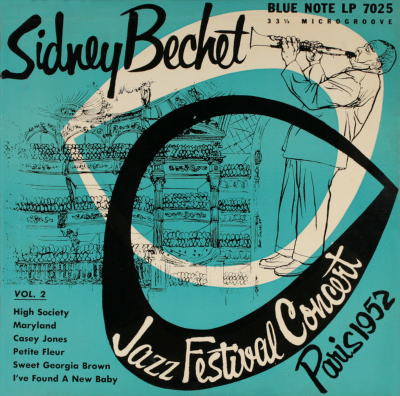
 Sidney Bechet - Jazz Festival Concert, Paris - Volume 2

Released - 1953

Recording and Session Information

"Salle Pleyel", Paris, France, January 31, 1952
Guy Longnon, Claude Rabanit, trumpet; Bernard Zacharias, trombone; Claude Luter, clarinet; Sidney Bechet, soprano sax; Christian Azzi, piano; Roland Bianchini, bass; Francois "Moustache" Galepides, drums.

Sweet Georgia Brown
Petite Fleur
Maryland, My Maryland

"Salle Pleyel", Paris, France, March 12, 1952
Guy Longnon, Claude Rabanit, trumpet; Bernard Zacharias, trombone; Claude Luter, clarinet; Sidney Bechet, soprano sax; Raymond Fol, piano; Roland Bianchini, bass; Francois "Moustache" Galepides, drums.

High Society
I've Found A New Baby
Casey Jones

Track Listing

Side One
TitleAuthorRecording Date
Sweet Georgia BrownPinkardJanuary 31 1952
High SocietyWilliams-PironMarch 12 1952
Petite FleurSidney BechetJanuary 31 1952
Side Two
I've Found A New BabyPalmer-WilliamsMarch 12 1952
Casey JonesSeibert-NewtonMarch 12 1952
Maryland, My MarylandTraditionalJanuary 31 1952

Liner Notes

...