Search This Blog

Showing posts with label JIMMY MCGRIFF. Show all posts

BST 84374

Jimmy McGriff - Black Pearl

Released - 1971

Recording and Session Information

"The Golden Slipper", Newark, NJ, early 1971
Ronald White, trumpet; Joseph Morris, alto sax; Arthur "Fats" Theus, tenor sax; William Thorpe, baritone sax; Jimmy McGriff, organ; O'Donel "Butch" Levy, guitar; Willie Jenkins, drums.

UAST-8095 Black Pearl
UAST-8096 Groove Alley
In A Mellow Tone
C Jam Blues
Ode To Billie Joe
Man From Bad

Track Listing

Side One
TitleAuthorRecording Date
Black PearlPierre Daniel, Sonny Lester1971
In a Mellow ToneDuke Ellington1971
Man from BadJimmy McGriff1971
Ode to Billie JoeBobby Gentry1971
Side Two
Groove AlleyJimmy McGriff1971
C Jam BluesBarney Bigard, Duke Ellington1971

Liner Notes

...

75th Anniversary Reissue Notes


BST 84364

Jimmy McGriff - Something To Listen To

Released - 1970

Recording and Session Information

NYC, circa fall 1970
unknown, tenor sax; Jimmy McGriff, organ; unknown, guitar; unknown, drums; unidentified orchestra.

Indiana
Malcolm's Blues
Satin Doll
Deb Sombo
Something To Listen To
Shiny Stockings

Track Listing

Side One
TitleAuthorRecording Date
(Back Home Again in) IndianaJames F. Hanley, Ballard MacDonaldFall 1970
Malcolm's BluesJimmy McGriffFall 1970
Satin DollDuke Ellington, Johnny Mercer, Billy StrayhornFall 1970
Side Two
Deb SomboJimmy McGriffFall 1970
Something to Listen ToJimmy McGriffFall 1970
Shiny StockingsFrank FosterFall 1970

Liner Notes

The organ has finally come into its own as a legitimate jazz instrument, although the subject has caused much debate in jazz circles. Because of its great versatility, its ability to provide multicolored shading—from funky, staccato rhythms to quiet church-like music the organ has proven extremely valuable in the genre of jazz, and even hard-core traditionalists are coming around.

With the emergence of new musical expressions and styles, new and young proponents of the art must inevitably rise to prominence. Step up, Jimmy McGriff, a young man with the talent and experience to make the organ talk jazz. He covers a wide range of musical expression, without gimmickry, with a straightforward approach to what is real, the guts of jazz.

Through years of experimentation, Jimmy has developed a very personalized style of organ, a style that is more possible in jazz because of its free-flowing, improvisational structure, than in any other type of music.

Jazz has few restrictions, few boundaries to bind — and therein lay its great attraction. Jimmy McGriff has the power over the music in blending his talents with the basic composition. His music is magnetic, pulsating With the excitement, beat and melody that make up the unexplainable charm of good music.


BST 84350

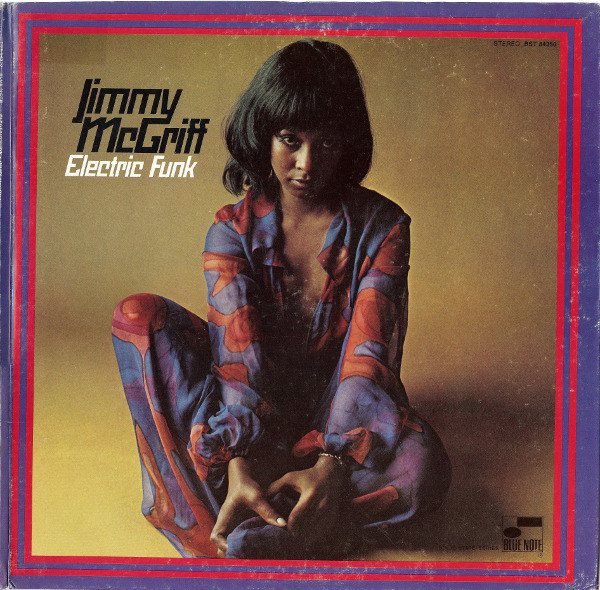
Jimmy McGriff - Electric Funk


Released - August 1970

Recording and Session Information

NYC, September, 1969
Blue Mitchell, trumpet; Stanley Turrentine, tenor sax; Jimmy McGriff, organ; Horace Ott, electric piano, arranger; unknown, guitar; unknown, electric bass; unknown, drums.

SD-5845 Back On The Track
SD-5846 Chris Cross
Miss People
The Bird Wave
Spear For Moon Dog, Part 1
Spear For Moon Dog, Part 2
Tight Time
Spinning Wheel
Funky Junk

Track Listing

Side One
TitleAuthorRecording Date
Back on the TrackHorace OttSep-70
Chris CrossHorace OttSep-70
Miss PoopieHorace OttSep-70
The Bird WaveJimmy McGriffSep-70
Spear for Moondog Part 1Jimmy McGriffSep-70
Side Two
Spear for Moondog Part 2Jimmy McGriffSep-70
Tight TimesHorace OttSep-70
Spinning WheelDavid Clayton-ThomasSep-70
Funky JunkHorace OttSep-70

Liner Notes

As old precepts and concepts about music come tumblin' down as in the days when Joshua was doing his thing, a whole new spectrum of musical integration seems to be emerging from the dogmatic rubble. Take jazz, as it used to relate to the organ. At one time the organ was considered a dirty word among people who manufactured public opinion about "what was, or was not acceptable in a jazz combo, band or orchestra." It was strictly a tool for rock and roll musicians to create a less than pure atmosphere of frenzy for a bunch of wildly undulating teeny-boppers. "Critics" are always right, aren't they?

Now all this has changed drastically. For starters, rock has finally taken its rightful place among the genuine forms of music that have developed and evolved in our culture. Its roots have been traced further back than most people who are alive today can remember. It can be perceived in blues, gospel, folk music and, with increasing effectiveness, jazz. In addition, almost every instrument used in the current presentation or in the overall development of this mode of expression is considered "Acceptable" if it enhances the desired projection of a style or mood. Further, the gap between jazz and rock has been bridged to such an extent that they both can be found interwoven in the repertoire of many of the top record sellers of our day.

All of this prelude now brings us to Jimmy McGriff, one of the finest organists (jazz, rock or otherwise) in the vast community of modern musicians. For the last few years, his albums have been persistent testimony to individualism, His protean ability and nonrestricted approach to everything his musical taste favors have made it impossible to fit him within the boundaries of one category. He originates and then develops and in doing so presents a total picture of himself.

"Electric Funk" is the latest in the constantly evolving story of Jimmy McGriff. It's a complete experience of thought and ability. Although the title connotes a purely upbeat rendering, "Funk" offers a mixture of tempo and feeling and in two cuts "Spear For Moon Dog" (Parts I & Il) McGriff shows a great deal of musical compassion (Moon Dog is a blind man who can be found almost any day in New York City's mid-town area dressed as a Viking and carrying a spear. He never begs money, he just listens to the world around him).

As previously stated, things have changed and the talent and incisiveness of one James Harrill McGriff stands out as one of the most convincing tributes to progress.

—JEFF SMERIN

PRODUCED BY SONNY LESTER
RECORDED IN SEPTEMBER 1969