Search This Blog

Showing posts with label UDISCOVER. Show all posts

BLP 4151

Andrew Hill - Black Fire

Released - May 1964

Recording and Session Information

Van Gelder Studio, Englewood Cliffs, NJ, November 8, 1963
Joe Henderson, tenor sax #1-3,5,7; Andrew Hill, piano; Richard Davis, bass; Roy Haynes, drums #1,2,4-7.

tk.3 Land Of Nod
tk.9 Cantarnos
tk.15 McNeil Island
tk.17 Tired Trade
tk.20 Pumpkin
tk.23 Subterfuge
tk.27 Black Fire

Session Photos


Rehearsal

Photos: Francis Wolff

Track Listing

Side One
TitleAuthorRecording Date
PumpkinAndrew Hill08 November 1963
SubterfugeAndrew Hill08 November 1963
Black FireAndrew Hill08 November 1963
Side Two
CantarnosAndrew Hill08 November 1963
Tired TradeAndrew Hill08 November 1963
McNeil IslandAndrew Hill08 November 1963

Liner Notes

Any avant-garde develops in waves, with the first wave of innovators attacking the academy’s shibboleths head on, and the second wave operating in the relatively less hostile and freer atmosphere created by their progenitors. Movements in jazz come about in such a fashion. Four or so years ago there was John Coltrane, Cecil Taylor, and Ornette Coleman and their coteries, and almost no one else who was concerned with methodology which was not essentially mainstream. By this I don’t mean to suggest that there were no other individuals or talent with recognizable styles playing jazz four years ago, nor do l mean to optimize the shock value of music that is merely different. But that there has been until almost yesterday a sickening familiarity about the jazz mainstream, and that the most apparent extra-musical value of Coltrane, Coleman and Taylor has been that they’ve made the jazz mainstream uncomfortable in its learned devices, and thereby liberated younger musicians whose main interest in music is finding their own voice through playing jazz.

The musical value of these innovators is that they’ve reconstructed the broader systems of group and solo playing in vitally useful fashions. Coltrane’s contribution may be said to be in harmonic improvisation, Coleman’s in rhythmic structure, and Taylor’s in tonal progressions. None of these concerns is antithetical to the others, nor has one man's preoccupation with the techniques of, say, chord based improvisation, precluded a manifest interest in rhythmically free group improvisation; but the academy of the ’50s left us with such pat approaches to all aspects of jazz playing that it required a life’s work to break down any of the particulars of the established concept.

So a musician like Andrew Hill occurs who has a relatively freer sense of time, harmonies, chord changes, group action, melody, etc., all focused into a style recognizably his own. It's not that he’s garnished the elements of his music from the innovators discussed above, but that the incidental benefit of being a part of the second wave of the avant-garde is that one can relax and make his own music without having to feel that one has to do it all, that is, beat down all the shibboleths singlehandedly to the accompaniment of the derision of one’s peers.

You can hear it all on Andrew Hill's first date as a leader: Roy Haynes playing a cadence which sharply contrasts with that of Richard Davis and Joe Henderson; Hill putting chord changes under the saxophone that take Henderson far, far beyond his point of departure in his earlier Blue Note date; Hill’s own soloing, with a style that includes most of the history of modern jazz piano playing without losing its individuality; a music, finally, whose total preconceived effect is a kind of contemporary impressionism.

Andrew Hill was born in Port au Prince, Haiti, in 1936. His family moved to Chicago when he was 4 "so that we could starve a little better,” where Hill, a sickly child, attended the University of Chicago Experimental School. Hill started playing jazz at 13 with his own ”baby band,“ a trio which used to copy all the techniques then on the Chicago air. He remembers copying Bud Powell’s, Thelonious Monk’s and Art Tatum’s solos verbatim, and it is these three gurus who one hears most in Hill’s playing.

“Monk’s like Ravel and Debussy to me, in that he’s put a lot of personality into his playing, and no matter what the technical contributions of Monk’s music are, it is the personality of the music which makes it, finally. Bud is an even greater influence but his music is a dead end. I mean, if you stay with Bud too much, you’ll always sound like him, even if you’re doing something he never did. Tatum, well, all modern piano playing’s Tatum."

Richard Davis has been called the new Percy Heath, by which I certainly don’t mean to suggest that there’s anything wrong with the old Percy Heath. The analogy means that Davis is a bassist with a distinctly masculine style who can do anything the leader requires at him while moving the band with a rock hard spontaneity that’s all his own. Like Hill and Henderson, it’s a very safe bet to say that Richard Davis will become a major force on his instrument.

Roy Haynes, the Beerbohm of bebop, "the best of the bebop drummers,” ”the most complete drummer in modern jazz,” well, Roy Haynes is Roy Haynes, the one jazz musician of whom I have never heard it said that he gave a bad or indifferent performance.

Andrew Hill has a deep appreciation for these musicians, he feels that scoring for each man’s talents is the best way to achieve a genuinely communicative group performance, and that only in a group that communicates and that moves can he get to his own highly personal music.

Since I don’t find it particularly useful to describe every tune in a set, as the listener will have to fit them to his own ear anyway, I'll use one tune as an example of how Hill manages to achieve a subtly programmatic and difficult end by using all the peculiar skills of his side men. Subterfuge he says, represents ”people talking, saying one thing when they are really meaning something else.” Then he’s describing conversation.

But the tune has a Latin base that’s certainly apparent enough though Hill has a studied aversion to playing directly on the beat. “That’s simply playing bebop, that 1, 2, 3, 4 pattern. I’d rather imply the beat than pronounce it.” Subterfuge opens with a 4 bar head which Hill means to be the tone of the conversation. This head is followed by a sharply different refrain, which Hill means to suggest the actual thoughts of the speaker. Through the denouement of the tune, the group improvises around the first line, but Hill insistently repeats the refrain every 4 bars. The contrast is kept up, and takes on new meanings. The dialogue in the beginning is between piano and piano, thereafter between piano and drums, piano and bass, horn and group. The solos, like Richard Davis’, are fabulous, and have an unusual context: the entire tune is articulate programmatically, musically, and personally, and that’s not an easy thing.

- A.B. SPELLMAN

RVG CD Reissue Liner Notes

A NEW LOOK AT BLACK FIRE

Some corrections and qualifications to A. B. Spellman's original liner notes are an order. Hill was born in Chicago, not Haiti — a fabrication of the pianist's own doing that was perpetuated for several decades. This was not his first album as a leader, although it appears that all commentators of the time also overlooked the obscure Warwick session So in Love with the Sound of Andrew Hill, which disappeared almost immediately upon issuance at the end of the '50s. And, given his low profile outside of Chicago, it is understandable that Spellman got the first name of saxophonist Von Freeman wrong.

Of perhaps greater concern to the appreciation of the present music is Spellman's placement of Hill within the second wave of the '60s avant-garde. Surely Hill would push at the accepted boundaries of modern jazz with greater force in later efforts, but here he is best appreciated as a complex and highly personal voice within the accepted rules of chord changes and chorus structures. Michael Cuscuna, the producer of the RVG reissue series, was much closer to the truth, at least regarding Black Fire, when he wrote in 1995 that "although [Hill's] music had melody, harmony, and rhythm, his conception of each was so unique that he was categorized with the avant-garde. This music was avant-garde in the strictest sense, but it was anything but free form. As Monk was lumped into the bebop movement because he was there, so was Andrew put into the freedom bag. His music was free of cliché, but that was about the extent of it."

Indeed, there is a resolute sense of form, albeit idiosyncratic form, in the compositions heard here. In addition to the sustained contrast of "Subterfuge" that Spellman discusses, note the irregular phrase lengths, even when A-A-B-A schemes are applied, of "Pumpkin" and "Tired Trade," and the even more curious shapes of "McNeil Island" and "Land of Nod"; the abstracted Latin feeling of the modal "Cantarnos"; and the contrasting use of triple meter in "Land of Nod" and the title track. Unlike many composers who write unusual wrinkles into their music, Hill does not abandon his notions for more conventional blowing forms once the solo choruses arrive. There are glimpses of his acknowledged sources (especially on "McNeil Island," which is as close as this listener can recall anyone coming to the aura of "Monk's Mood"), but for the most part Hill is revealed here as sui generis.

His playing is also far more than Monk-plus-technique, which again was the way that many commentators treated Hill at the time. Dissonance and angularity may have made the comparisons obvious, yet there is a swift, overflowing quality to Hill's creations that set them distinctly apart from Monk's more blunt and concise notions. The brusque, rolling and tumbling quality of Hill's improvising was reinforced perfectly by his accompanists here, particularly Roy Haynes, whose polyrhythmic genius finds an ideal forum in Hill's music. How odd that Philly Joe Jones was originally slated to play on the album, and was only replaced after scheduling problems made him unavailable. Richard Davis, the ideal blend of virtuosity and idiosyncrasy, adds his own prickly edge, while Joe Henderson rises to the unconventional challenges here with some of his strongest recorded playing. Each of these men would record with Hill again, with Davis becoming a mainstay on Hill's next five Blue Note sessions as well as on Bobby Hutcherson's Dialogue, where Hill played piano and contributed the majority of the compositions.

Hill also deserves applause for constructing the present program in such a felicitous manner. He avoids routine by mixing three trio tracks (Henderson is out on "Subterfuge" and "Tired Trade," Haynes on "McNeil Island"), and by varying the solo sequences. And there are few if any albums around that leave as much room for bass and drum solos while avoiding the rote quality that often ensues when every member of the band is afforded improvising space. Davis's audacity and Haynes's insistence on a melodic approach to percussion has a lot to do with this; but Hill provided the inspiration that encouraged the bassist and drummer to respond with such creativity. Two alternate takes are included here, and each was under consideration for release when the original album was assembled.

Other triumphs lay ahead for Hill on Blue Note. A short list would have to include the Point of Departure session in March '64 where the pianist, Henderson, and Davis were joined by Kenny Dorham, Eric Dolphy, and Tony Williams; and the recently unearthed Passing Ships nonet from 1969. Black Fire belongs among these as one of the recordings that define the genius of the still-amazing Andrew Hill, and one of the greatest "debut" albums of the '60s.

— Bob Blumenthal, 2003

Udiscover Notes

https://www.udiscovermusic.com/stories/black-fire-andrew-hill-blue-note-album/

On Friday, November 8, 1963, Andrew Hill walked into Van Gelder Studio at Englewood Cliffs, New Jersey, for his maiden recording session for Blue Note Records. Following a second stint at the studio the following day, he emerged with Black Fire. It marked the beginning of what would be the first, and longest, of three separate stints (1963-70, 1989-90 and 2006) with Alfred Lion and Francis Wolff’s iconic New York-based jazz label.

But anyone that regarded Hill, then a 32-year-old pianist/composer originally from Chicago, as a recording novice was very mistaken. He had, in fact, recorded a brace of 10” singles for the small Ping label, in 1956, and that same year cut a long-forgotten trio album (So In Love) for Warwick, which consisted mostly of standards and didn’t get released until 1960. More significantly, just prior to his debut Blue Note session, he worked on albums by multi-instrumentalist Roland Kirk (before the latter prefixed his name with Rahsaan) and vibraphonist Walt Dickerson. It’s also worth noting that Miles Davis must have held Hill in high regard, as he hired the pianist to play on some of his band’s Chicago gigs in the mid-to-late 50s.

Brimming with passion Though Black Fire was only his second solo recording, it’s a mature, fully-formed collection of self-penned material revealing that Hill had already discovered his own distinctive voice in jazz. His sui generis approach to melody, harmony, rhythm and compositional structure has no parallel, except, perhaps, in the similarly idiosyncratic figure of Thelonious Monk, also a pianist/composer who created his own personalized form of jazz.

Monk certainly exerted a big influence on Hill, especially in regard to the latter’s angular chromatic melodies and jaunty rhythms, but, as Black Fire reveals, Hill’s concept was entirely individual. In fact, the latter’s take on jazz was so different from the bop mentality that largely prevailed at Blue Note that he found it difficult to find simpatico musicians on the same wavelength. This resulted in a great many of his later sessions for the label (such as Dance With Death and Passing Ships) being shelved until later dates.

Thankfully, on Black Fire, Hill doesn’t have this problem and leads a fine, intuitive quartet that seems to be wholly in tune with him as well as the sometimes exacting demands of his material. The estimable Joe Henderson, renowned for his robust, growling tenor saxophone (and who, in 1963, had just released his Blue Note debut LP, Page One) is the only horn player present, while the rhythm section consists of Hill’s fellow Chicagoan, bassist Richard Davis, and noted drummer Roy Haynes (who, at 39, was the oldest member of the quartet). The latter brought with him much experience and a highly-nuanced polyrhythmic style that would both complement and enhance Hill’s music.

The first notes we hear on the album are Haynes’, coming from his busy hi-hat and cymbal patterns in tandem with Davis’ elastic bass. Together, they announce the opening bars to “Pumpkin,” the first of seven original Hill tunes on the album. The piece boasts a knotty but memorable main theme, enunciated by Henderson’s sax, before Hill takes the first solo; its tumbling sequence of notes epitomizes the composer’s singular piano style. Henderson, meanwhile, navigates his way through the tricky changes with aplomb.

A highly original musical mind Hill’s piano is more jagged on “Subterfuge,” which sees the 26-year-old Joe Henderson sit out. The song is built on throbbing ostinato rhythms churned out by Haynes and Davis, who are both allowed solo spots. In sharp contrast, the album’s title tune, rendered in a jaunty 3/4 time, finds Henderson back in the fold and is distinguished by a highly infectious Monk-like main theme.

“Cantaros” is different again and defined by a quasi Latin-esque rhythm, though it’s far from conventional: the Hispanic influence is implied rather than stated, and refracted through the prism of Hill’s imagination. “Tired Trade,” meanwhile, has more of a blues feel, though, again, it’s not entirely orthodox. With Henderson dropping out once more, reducing the group to a trio, Hill’s roving piano is the main focus and it allows us to get a good glimpse of his slightly stilted playing style. There are also solo passages by Davis and the ever-ingenious Haynes.

“McNeil Island” – named after a small piece of land in Washington’s Puget Sound – is a short ballad that reveals Hill’s more meditative side, though the sense of stillness it creates is quickly dispelled by Black Fire’s closing cut, “Land Of Nod,” which begins almost raucously thanks to Joe Henderson’s spirited blowing of the main melody over staggering, almost ramshackle rhythms. In truth, though, it’s a track defined by a subtle ebb and flow, between loud passages and softer, more pensive ones.

Though considered to be in the vanguard of avant-garde music, Andrew Hill most certainly wasn’t an apostle of free jazz. In fact, as Black Fire reveals, one of his distinguishing characteristics as a jazz composer was his frequent employment of form and structure, albeit in an unorthodox fashion. Hill’s music could seem oblique and cerebral, perhaps, but it was actually brimming with passion and refreshingly free of bebop clichés. It was also deeply personal and indicative of a highly original musical mind.

While Point Of Departure, recorded for Blue Note four months later, is rightly regarded as Hill’s magnum opus, Black Fire doesn’t lag very far behind in terms of its quality and significance. It, along with many of Hill’s other Blue Note sessions from the same timeframe, has aged exceedingly well. Over five decades after it was recorded, the music on Black Fire still burns brightly.


BLP 4126

Herbie Hancock - My Point Of View


Released - August 1963

Recording and Session Information

Van Gelder Studio, Englewood Cliffs, NJ, March 19, 1963
Donald Byrd, trumpet; Grachan Moncur III, trombone #2,4,5; Hank Mobley, tenor sax; Herbie Hancock, piano; Grant Green, guitar #3,5; Chuck Israels, bass; Anthony Williams, drums.

tk.2 A Tribute To Someone
tk.8 King Cobra
tk.10 Blind Man, Blind Man
tk.17 The Pleasure Is Mine
tk.20 And What If I Don't Know

Session Photos


Photos: Francis Wolff

Track Listing

Side One
TitleAuthorRecording Date
Blind Man, Blind ManHerbie Hancock19 March 1963
A Tribute to SomeoneHerbie Hancock19 March 1963
Side Two
King CobraHerbie Hancock19 March 1963
The Pleasure Is MineHerbie Hancock19 March 1963
And What If I Don'tHerbie Hancock19 March 1963

Liner Notes

THIS is Herbie Hancock’s second album as a leader for Blue Note. The title of his first, Takin' Off, (4109) was certainly prophetic. With that album he achieved success on several levels. His talent, immediately recognizable in his debut with Donald Byrd on Royal Flush (4101) really was brought into focus, for in the role of leader, Herbie not only was thrust more into the solo spotlight, but all six compositions were written by him. These ranged in style from an arresting, pretty ballad Alone and I, to a number with a section of free improvisation, The Maze. In between, there were some blues, among others. One of them, Watermelon Mon, reached the ears of a public that usually does not buy jazz. When it reached their ears they reached into their pockets. Herbie Hancock had a “hit”.

What has been the result of this sudden good fortune? Has success spoiled “Rock” Hancock? To say, “not at all”, would be a refutation of the exuberance and vitality of youth. After all, Herbie had just turned 23 years old in the midst of everything. By way of celebration, he went out and bought himself a beautiful, snowy, showy sports car. But in discussing his new album, the music within this cover, Herbie made clear that when he is not riding in his car, he has his feet on the ground.

My Point of View, like its predecessor, Takin’ Off, demonstrates Hancock’s versatility. Again he has written all the selections and again they do not conform to any one style. This explains the unusual combination of individuals that Hancock assembled to interpret his compositions. Herbie explains: “The tunes are varied so I had to get musicians who were flexible.” Not only are they flexible, but all except drummer Anthony Williams are composers in their own right. Hancock believes this was no small aid in helping them to interpret his original material.

Donald Byrd, Honk Mobley and Grant Green are well known to jazz listeners for each is well represented by his own albums in the Blue Note catalogue. Grachan Moncur Ill is the son of the bassist who played with Al Cooper’s Savoy Sultans in the late Thirties and early Forties. The young trombonist first gained recognition with the Art Farmer-Benny Golson Jazztet during the lost year that organization was in existence. Recently he has been playing and recording with Jackie McLean. Moncur, like many contemporary trombonists, stems from J. J. Johnson but in his solo on King Cobra indicates o highly personal interpretation and extension of this idiom.

Chuck Israels has been the regular bassist with the Bill Evans trio since June 1961. Prior to that he studied at M.I.T. and Brandeis University, and played with Bud Powell in Paris in 1959. His is not an overpowering style but it features strength with sensitivity and reveals a keen ear.

Anthony Williams was Jackie McLean’s drummer when this recording was mode but as of this writing, he is about to join Miles Davis’ sextet. That this 17-year-old from Boston has poise and drumming intelligence beyond his age can be explicitly heard in this album. He obviously likes Roy Haynes and Elvin Jones but is already saying things of his own.

Blind Man, Blind Man is in the some genre as Watermelon Man. In both cases, Herbie wanted to write “something that reflected my Negro background. Since I didn’t grow up in the south, I don’t know anything about cotton fields or work songs, but I did see and hear a lot of things in my neighborhood in Chicago.” One of these was the blind man, standing on the corner with his guitar. Although the whole number embodies this feeling, the blind guitarist is specifically portrayed by Green’s guitar breaks which divide the theme statements. Grant continues the groove in his solo before Mobley speaks his piece in an impassioned usage of tone and space. Hancock uses funky patterns to a point of intensity in his two-handed solo.

A Tribute to Someone was written in 1959 when Herbie was a student at the Berklee School of Music in Boston, Moss. It was a collaboration with a fellow student, trumpeter John Scott, and evolved from a session the two had in a practice room. Scott asked Hancock to play some chords that would be good for blowing. The first half of the tune came out of this. Donald Byrd states the melody here with an assist from Mobley. Then both return for highly lyrical solos. Herbie plays a thoughtfully constructed, delicate yet swinging improvisation before Hank reenters to set the stage for Donald’s closing remarks.

Hancock wrote King Cobra because he was tired of the some chord progressions. “The chord in most jazz tunes flow in a certain way,” he explains. “I wanted to expand the flow so that it would go in directions beyond the usual.” The harmony builds tension, representing the cobra with its latent striking power. (Cobra is also the type of sports car that Herbie owns.) Notice the way bass and drums do not merely keep time but play accompanying figures. Herbie considers King Cobra a hard tune to play but he and Byrd, Mobley and Moncur, the three soloists who precede him, all communicate with invention and emotion. Williams ploys some ear-catching patterns throughout, especially at the very close.

The Pleasure is Mine is a richly voiced ballad that has Byrd playing the lead. “When I wrote it,” says Herbie, “I felt it slower. I just played it alone, but with horns it had to be faster.” This version is not fast, but a lovely performance by Hancock with sensitive accompaniment from Israels, including adept use of his bow. Herbie here tips his cop to one of his preferred pianists, Bill Evans.

“As a teenager, I went through my rhythm & blues days,” says Herbie, in talking about And What If I Don’t. “R&B may have been simple in harmony but it has a feeling that was close to the every day.” This 32-bar theme is a jazz tune but it does hove a strong bluesy feeling. The melody line, which incidentally, would lend itself well to lyrics, leads to some straight-forward swinging from Hancock, Green, Byrd and Mobley. The bridge has a Silvery gleam. “Although I’ve studied music for 16 years,’ Hancock says, “it is more meaningful to be now.” Since settling in New York, he has really discovered Bud Powell and Charlie Parker through records, and recently he has been listening to a lot of classical music. He feels that experience from all different areas of music has broadened his outlook. For instance, while he was a student at Grinnell College in Iowa, he worked with a guitar player who liked Barney Kessel. “But we played for the farmers — western, rock & roll.”

In playing with many combinations since then, Hancock has continued to stress adaptability. “When I play with a group, I play for that group,” he says. This he has done with Coleman Hawkins, Donald Byrd, Phil Woods and Clark Terry-Bob Brookmeyer. Hancock, the pianist, does not let down Hancock, the leader, either. His stated goal is “to hove a broad conception about everything,” which in thought and in deed, is o very healthy point of view.

— IRA GITLER

Cover Photo and Design by REID MILES
Recording by RUDY VAN GELDER

RVG CD Reissue Liner Notes

A NEW LOOK AT MY POINT OF VIEW

My Point of View was not Herbie Hancock's most popular Blue Note album, and next to such future triumphs as Empyrean Islands and Maiden Voyage it was hardly his profound; but it may have been his most prophetic. Jazz had reached a crossroads in 1963, and the options available to its best players pointed them in multiple directions. Hancock was poised, perhaps more completely than any of his generation, to succeed in a variety of roles - preserver of the music's best traditions, explorer of bold and challenging vistas, communicator in the larger public arena where jazz skills could inform a more basic and popular music. On this album, Hancock acknowledged an intent to excel in all of these areas.

He was given the latitude to do so, in part, because of the success that "Watermelon Man," the hit that crowned his prophetically named debut album as a leader, Takin' Off. That Blue Note and Hancock hoped to repeat that success is no surprise, just as the sense that artist and label are trying with "Blind Man, Blind Man" dooms the track to pale alongside its less calculated predecessor. The more important message that this session delivers regards Hancock's inability to be typecast, which is reinforced by the unusual cast of players that amplify the pianist's points of view. Donald Byrd and Hank Mobley had been teamed in front lines since the 1955 Jazz Messengers; Grachan Moncur III and Tony Williams were busy taking hard bop One Step Beyond in Jackie McLean's band; Chuck Israels had stepped into the seat where exploration and lyricism were most implicitly bonded, as Scott LaFaro's replacement in the Bill Evans trio; and Grant Green was the new voice of deep blue guitar, and a paragon of uptown soul. There are enough quality ingredients here for several gourmet meals, and Hancock took great care in how they were mixed.

The Byrd/Hancock connection might be considered the cornerstone of the pianist's career, for the had trumpeter had brought to Blue Note as a sideman in 1961. The most famous of Byrd's sessions featuring Hancock, A New Perspective was recorded two months before this date and also included Mobley, who proceeded to use Hancock and Byrd on a session of his own that took place on March 7. (This over-looked date, which produced such excellent performances as "Old World, New Imports," "Up A Step" and "East Of The Village," was initially spread over several Mobley albums and finally brought together on the 1989 Mobley CD Straight, No Filter.) The finest moments of those earlier encounters with Byrd and Mobley are matched on "A Tribute To Someone," where the strong melody and inspiring changes are set over a perfect medium tempo and the lineage of these Blue Note veterans is also honored in the shuffle beat of the Silverish "And What If I Don't?"

Things get even funkier on "Blind Man, Blind Man," where Grant Green makes his primary contribution to the session. As a new member of the Blue Note repertory Hancock had established his compatibility with the equally ubiquitous Green on the guitarist's Goin' West session (though the album went unreleased for several years) and the gospel-laden Feelin' The Spirit. The use of guitar (as well as trombone in the ensemble) helps set the track apart from "Watermelon Man," and Mobley also makes a strong contribution (and an effectively dramatic entrance). What really stands out is the way Hancock pushes the vamp into new shapes. Like the others, he is in better voice on the master take.

If "The Pleasure Is Mine" draws him closer to the harmonic language that Israels spoke in the Evans trio, the theme and the piano solo reveal a musician with his own touch and diction. Hancock also avails himself of the bassist's keen sense of the modal idiom on "King Cobra," where the Israels/Williams rhythm section makes the time pop and Moncur gets his to apply the necessary attitude to another memorable piece in yet another mood.

Of all the relationships that shape this album, the conjunction of Hancock and Williams is the one that would resonate most boldly in the future, and "King Cobra" is the clearest example of the inspiration these future Miles Davis band-members could provide for each other. Williams is spectacular at the fade of this track, though his comfort and imagination on each of the other compositions is also worth noting. He and Hancock were joining forces in Rudy Van Gelder's studio for the second time — the first, a February 11 Jackie McLean session that included Byrd, was not released until on the LP Vertigo. They would go on to make all kinds of magical music at Van Gelder's, including the fantastic Kenny Dorham date Una Mas less than two weeks after these performances.

- Bob Blumenthal, 1999

Complete Blue Note Sixties Sessions Liner Notes

The alternate version of “Blind Man, Blind Man” was done after the master was recorded. Herbie may not have been satisfied with the earlier version, and proceeded to record this take. He informed Alfred of a “new bass note.” It’s hard to say why some takes catch on more than others, but it seems that this tune cannot be played too many times in a row. “Blind Man, Blind Man” was Herbie’s sequel to “Watermelon Man,” the same inference to a street peddler, and a rock Solid groove.

On April 1, 1963, Kenny Dorham recorded an epic album for Blue Note, an album that captured the essence of Alfred Lion’s ideal sound. Una Mas (4127) featured the title track, a 15:17 groove treat that has become a staple of jazz musicians, and hooked up Kenny with Joe Henderson. With the rhythm section of Herbie, Butch Warren and Tony Williams, this record is a must have for any serious jazz fan.

A few days later, on the other side of the U.S., Miles Davis took a quintet into Shelly’s Manne-Hole for two weeks. At the end of the engagement, he entered Columbia’s Hollywood Studio and recorded for two days (April 14 and 15, 1963). This quintet was made up of Miles, George Coleman on tenor sax, Victor Feldman on piano, Ron Carter on bass and Frank Butler on drums. The sessions were difficult, and Miles seemed to be bothered by the whole thing. He had been having problems keeping a band on the road and out of trouble. Since Coltrane left in 1960, he enjoyed about a year and a half of stable personnel, but by the middle of 1962, things began to happen. Paul Chambers had legal problems, Hank Mobley quit, and Wynton Kelly wanted to go on his own, with both Chambers and Jimmy Cobb.

By late 1962, J.J. Johnson, Sonny Rollins and Red Garland had made brief stops in the band, and by the winter of 1962, his quintet settled into George Coleman on tenor, Harold Mabern on piano, Ron Carter on bass and Jimmy Cobb on drums. Frank Strozier’s alto was added to make it a sextet. During the Christmas holidays in New York, Miles began looking for a new drummer. “Philly Joe” Jones took Miles to see this young wizard playing with Jackie McLean, a 17-year-old wiz kid of the drums. As soon as Miles heard Tony Williams, he knew he was moving forward. Upon accepting the gig with Miles, Tony joined Ron Carter and George Coleman. Miles wanted a permanent pianist, and Victor Feldman had turned him down. Tony then recommended Herbie.

“I was playing for a singer named Judy something. She was a very, big girl and her thing was that she sang bawdy songs and risque songs…stuff like that.” Herbie recalled. It was at the Village Gate, and Clark Terry and Seldon Powell were also in the band. So one night Miles comes in, and Tony had called to tell me that Miles was gonna check me out. I never thought he’d come to the Gate, but he did. I think he had some gigs, and he couldn’t wait for me to get a gig in an optimum environment to check me out.” The famous story is that Herbie was called by Miles to make rehearsals. At the end of the last rehearsal, Miles announced that they would be going into the studio, and that there was a gig a few days later. Herbie, not being certain of his status, asked Miles, “Am I in the band?” “You making the gig ain’t you’ was Miles’s gruff response. At 11:OO pm on May 14, 1963, the new Miles Davis Quintet, featuring George Coleman, Ron Carter, Tony Williams and Herbie Hancock went into the Columbia Studios to finish what was to become the Miles Davis Seven Steps To Heaven album. (Columbia CL-2051).

With Miles Davis as his new employer, Herbie was now at the top of the heap for a young jazz musician. Working with Miles meant acceptance at a level that musicians rarely achieve. After a few gigs with Miles, Herbie was called for a Donald Byrd session on Blue Note on May 20, 1963. This session, which featured Jimmy Heath, Sonny Red and Tootie Heath was unissued until 1997, and then only one track was released (“All Members”). Herbie then went on the road with Miles Davis for a couple of months of touring. The Miles Davis Quintet was captured in St. Louis (June of 1963) on a verité recording, and issued as an LP in the 70s and as a CD in the 90s (Miles In St. Louis VGM-OOO3). The quintet made a smash debut at the Sutherland Lounge in Chicago (June) and ended their European adventure with a triumphant appearance at the Antibes Jazz Festival (released as Miles In Europe Columbia CL-2183). But it wasn’t until October 1963 when Seven Steps To Heaven was released that the record buying public got a chance to hear the new Miles Davis Quintet.

After a long summer, Miles relaxed in New York, and soon Herbie got a call to go into the studio for a Blue Mitchell session. Not released until 1980, Step Lightly (BN-LT-1082) featured Mitchell on trumpet, Joe Henderson on tenor, Leo Wright on alto and Blue’s rhythm section Gene Taylor and Roy Brooks (who were, coincidently, the rhythm section for Horace Silver). The recording is subtle and filled with the elegance of the blues. Herbie fits right in, maintaining that balance of art and skill.

Blue Note Spotlight - February 2013

http://www.bluenote.com/spotlight/herbies-point-of-view/

The 1999 CD reissue of Herbie Hancock’s My Point of View comes with an alternate take of “Blind Man, Blind Man.” And that take, recorded with the rest of the album on March 19, 1963, comes with a present. At the beginning of the track, Hancock starts to count the band off but interrupts himself. “Hey, Al?,” he says in an impossibly hip voice to View producer (and Blue Note founder) Alfred Lion. “Chuck is gonna try playing a different note on the bottom. Listen to see how this sounds. I think this’ll do it.” The Chuck in question is dependable Bill Evans bassist Chuck Israels, and he does what he’s told. But before the performance starts, and after “I think this’ll do it,” comes the big line: “If it’s cool, don’t say anything.”

If it’s cool, don’t say anything. For Hancock, then twenty-two years old and already recording his second album as a leader (his first, Takin’ Off, was also for Blue Note), music was everything. Words weren’t necessary. Vibe was huge. If it feels good, we’ll all know it. So only say something if it’s not working. If it’s cool, don’t say anything.

Brought into being by the imposing septet of trumpeter Donald Byrd, trombonist Grachan Moncur III, tenor saxophonist Hank Mobley, guitarist Grant Green, drummer Tony Williams (then seventeen years old and billed as “Anthony”), Israels, and Hancock, the five-song My Point of View is a variety show in four acts. The Latin portion of the evening arrives in the form of the aforementioned “Blind Man, Blind Man,” which Blue Note clearly hoped would repeat the success of 1962’s similar-sounding “Watermelon Man”—the cover of View reads: “Includes his new composition ‘Blind Man, Blind Man.’”

On top of funky piano vamping, a gentle bass ostinato, and a subtle beat from Williams, the horns massage a simple, catchy melody. But the piece, named for a blind guitarist the leader encountered on a street corner while growing up in Chicago, is most memorable for the pair of saucy breaks shared by Hancock and Green alone. Even though they’re composed, one feels thankful during the song-ending head for the opportunity to hear the combination of just Green’s sleek six-string and Hancock’s knowing piano again. Green and Hancock had met in the studio before—on the sessions for Green’s albums Goin’ West and Feelin’ the Spirit—and they would hook up again, on Lee Morgan’s Search for the New Land and Byrd’s I’m Tryin’ to Get Home.

The album’s ghost story is the foreboding “King Cobra.” Centered around the pumping piano rhythm that, when slowed down, would become the foundation of Hancock’s “Maiden Voyage,” “Cobra” features an enigmatic three-part horn melody that floats and moans and rises and falls. The first to go one-on-one with the snake is Byrd, whose improvisation is tough and fearless. Mobley follows with a strong attack, too, but Moncur holds up best against the beast, calmly riffing it into a corner. After a lively pep talk from Hancock, Williams has the last word, capturing the cobra with sharp hi-hat smacks, tasteful tom taps, and determined snare hits.

The seven-piece takes it to Soulsville with the defiantly titled “And What If I Don’t.” Taken at a down-home, moseying pace and beginning with a heartbreaking move from Eb down to C in the bass, “Don’t” moves its horn trio from the jazz club to the back porch with an uncomplicated, down-but-not-out melody. Green is right at home in these environs, issuing a short but gut-wrenching dispatch between bursts of creativity from the leader and Byrd. Mobley turns in perhaps the most affecting improvisation of the take, though, grooving and blues-ing with world-weariness and heart. In the original liner notes, on the topic of “Don’t,” Hancock tells Ira Gitler, “R&B may have been simple in harmony but it has a feeling that was close to the everyday.” With “Don’t,” Hancock cozies up to that emotion.

The ballad section of the night washes ashore in two waves: “A Tribute to Someone” and “The Pleasure is Mine.” Penned while Hancock was still a teenager, “Tribute” opens with the leader dropping harmonies both bright and curious over an F bass pedal. Then it’s off to the sleepy races, with Byrd and Mobley delivering the composition’s romantic, lyrical composed lines. Post-head, Byrd matches soulful strutting with swift asides; Mobley turns in joyful, smiling comments; and Hancock gives crisp, sparkling notes. The song ends on the same insistent F that got it started, this time decorated with a dissonant chord from Hancock and a legato cry from Byrd. “The Pleasure Is Mine” begins ominously, but soon brings out a lush, satisfied intertwining of Mobley, Moncur, and Byrd. The only solo belongs to Hancock, but it’s gorgeous—tones scamper and skip, sashay and swing.

Circling back around to the alternate take of “Blind Man, Blind Man,” which brings the ’99 CD reissue of View to a close, it must have been a difficult call deciding which version to place on the original album. On the alternate take, the ensemble sounds tight, and the improvisations from Green and Mobley are inspired. But Israels’s original bass note sounds better, and that elusive Special Something is missing.

More than just an ambitious early effort from the Chameleon, View was also Hancock’s last album before joining the big leagues. Less than two months after the recording of View, Hancock, Williams, and bassist Ron Carter were summoned to Miles Davis’s home for a session. While the rhythm section jammed, the trumpeter listened in another room over an intercom. This went on for three days, and on the third day, Davis was joined by two more observers: Gil Evans and Philly Joe Jones. At the conclusion of the jam attended by Evans and Jones, the trio was informed that the following day’s music would be made in the studio. On May 14, Hancock officially joined the Miles Davis Quintet by bringing his point of view to three tracks that would be included on the album Seven Steps to Heaven.


BLP 4104

Art Blakey and the Jazz Messengers - Buhaina's Delight

Released - June 1963

Recording and Session Information

Van Gelder Studio, Englewood Cliffs, NJ, November 28, 1961
Freddie Hubbard, trumpet; Curtis Fuller, trombone; Wayne Shorter, tenor sax; Cedar Walton, piano; Jymie Merritt, bass; Art Blakey, drums.

tk.6 Moon River
tk.8 Contemplation

Van Gelder Studio, Englewood Cliffs, NJ, December 18, 1961
Freddie Hubbard, trumpet; Curtis Fuller, trombone; Wayne Shorter, tenor sax; Cedar Walton, piano; Jymie Merritt, bass; Art Blakey, drums.

tk.1 Reincarnation Blues
tk.7 Backstage Sally
tk.10 Bu's Delight
tk.12 Shaky Jake

Session Photos


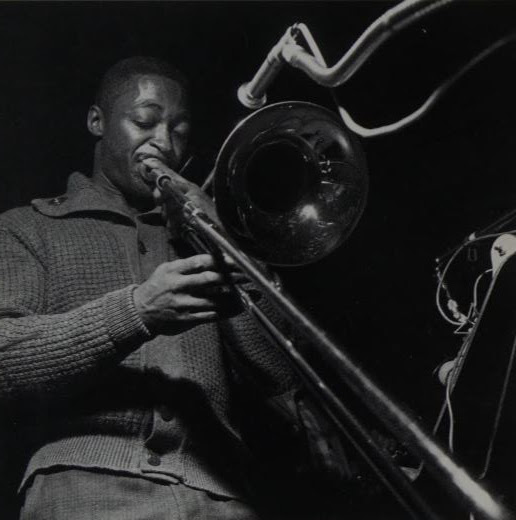
Curtis Fuller

Photos: Francis Wolff

Track Listing

Side One
TitleAuthorRecording Date
Backstage SallyWayne Shorter18 December 1961
ContemplationWayne Shorter28 November 1961
Bu's DelightCurtis Fuller18 December 1961
Side Two
Reincarnation BluesWayne Shorter18 December 1961
Shaky JakeCedar Walton18 December 1961
Moon RiverHenry Mancini, Johnny Mercer28 November 1961

Liner Notes

ART BLAKEY, for years an eager conveyor of the jazz message verbal or musical - to anyone who would listen, in every country has visited, is convinced that things are getting better. Not just better for the Jazz Messengers, but better for jazz, better on the social scene for musicians as a whole.

Recently the band that can be heard on these sides paid a visit to ”dirt-road. a town never regarded by Art or anyone else as the country’s foremost center of jazz appreciation. Opening an engagement at Ben Shapiro’s Renaissance on the Sunset Strip, Art had misgivings. His last visit to Los Angeles a year earlier, to play o now-defunct club, had been less than encouraging; moreover, the acclaim he had since enjoyed in Japan, and more recent in a jet-propelled 18-day hop through Europe, convinced him that the American prophets of modern music could never be comparably honored in their own country.

Walking in an opening night l was greeted by an admirable sight and a stimulating sound. The sight was a long line of customers outside the club, trying to get in; the sound was that of the sextet playing Curtis Fuller’s Arabia, one at the most impressive tracks in the group's last LP, Mosaic (Blue Note [{BLP4090]]).

What is most remarkable about the Messengers today is that their ensemble quality is in every way the equal of their individual talents. Too often you find (and-one very famous case comes instantly to mind) that a jazz sextet may consist simply of a rhythm section and three brilliant hornmen who show no particular concern for each other, whose ancestral efforts are casual first-and-last-chorus throwaways, a mere short-cut to the blowing.

Art and his men, more than ever now that they are six strong, are mindful of the inescapable fact that a combo, no matter how large or small, is still an orchestra - a group of men working toward a common end. This, at course, in no way inhibits the soloists; on the contrary, the prevailing enthusiasm in the group has spurred the members to performances that show more authority and zeal than ever.

Billy Eckstine band, we were playing some real music - some of the greatest big band jazz of the day - and the poor people didn‘t know what we were doing to them!

You know, people can dance to our music, now, and the office is talking about booking us on some college dates, where we can play a concert followed by a dance. l'd dig that.“

Though its danceability may seem an irrelevant factor to those chiefly concerned with the strictly musical values of the Messengers, it is not without significance that the rhythmic qualities of the group do offer this possibility. lt is important that the sextet does not indulge in such devices as violent changes of mood, meter and tempo in the middle of a number. and that Art’s own contribution, supported by Jymie Merritt‘s and Cedar Walton's, never buries the essential basic beat for all its astonishing complexity.

The music on these sides reflects the jubilant spirit of the combo in both title and music. Buhaina, of course, is Abdulloh lbn Buhaina, alias Art Blakey. One of the first iazzmen to have been attracted to the tenets of Islam, he does not use the name professionally.

Wayne Shorter, whose Children of the Night was heard in the previous sextet LP, wrote all but two of the arrangements for this date. "It was something of a new departure for me, too," he says, "as I wrote all of them away from the piano. I found out that working without a piano you get a different approach, a broader outlook."

Backstage Sally, says Wayne, was a little brainstorm he got to sketch a musical portrait of "the kind of girl you're liable to meet backstage, no matter what band you're with or what town you're in." Built on a 16-bar pattern, it features solos by Wayne, Curtis, Freddie and Cedar.

Contemplation is a slow, nostalgic ballad. the first composition of this kind ever attempted by Wayne. Its mood is achieved through the use of an unusual and most attractive chord pattern that starts deceptively in C and moves to A Flat, D Flat and B Flat.

Bu‘s Delight, written by Curtis Fuller a few months ago in Chicago, has a 64-bar theme, with Art‘s breaks filling the gaps in the main thematic statement. and with a 16-bar release built on a C Minor chord. Though there are valuable contributions by the three horns and Cedar, this nine-minute track belongs essentially to the leader, who in the course of a three-and-a-half-minute solo builds from a simple hi-hat offbeot to a series of slow and magnificently executed crescendos. Nobody else in life can make a press-roll mean as much as Art can. and it is extremely doubtful that any other drummer can achieve a comparable blend of technical mastery and rhythmic excitement.

Reincarnation Blues, another Wayne Shorter original, is founded not on the regular 12-bar blues structure but on a 16-bar pattern. Freddie Hubbard's solo is especially impressive here with its dramatic tension and sense of overall form.

Shaky Jake is the work of Cedar Walton, who wrote the title number of the sextet’s last LP, Mosaic. The first four measures are introductory; the chorus that follows runs 12-12-8-12. This is a delightfully blues-oriented work, mainly through the emphasis in the melody on the flat third (G Flat in the key at E Flat) throughout the opening 12-bar strain.

Hank Mancini's Moon River was arranged by Wayne Shorter, who observes: "I heard this tune on the air, and later I saw the picture; although I've arranged very few standards, I felt this would make a good piece of material for the group." Conceived as a slow waltz, the melody is transformed here into a briskly swinging 4/4.

It is easy to tell, on listening to these six performances by six brilliant artists, that the optimistic mood of Art Blakey has been communicated to his sidemen. As Wayne Shorter put it, "There's a feeling in the band that everybody wants to contribute, wants to add new music to the book - not just for the sake of the royalties, but out of genuine interest in what's happening with the group."

No wonder Art Blakey takes such pride and pleasure in "the youngsters," as he affectionately calls his colleagues. It's true that Art has been on the scene a while, but let's not forget he's still a couple of years younger than our young President. The Messengers, by the way, have just completed their second - it was just eight years ago that the original memorable session by the old Blakey Quintet, with Clifford Brown, was recorded at Birdland - and nobody is happier than I that in jazz there is no anti-third-term legislation.

- LEONARD FEATHER

Cover Photo by FRANCIS WOLFF
Cover Design by REID MILES
Recording by RUDY VAN GELDER

Wayne Shorter performs by courtesy of Vee Jay Records.
Curtis Fuller performs by courtesy of Ampar Records

RVG CD Reissue Liner Notes

A NEW LOOK AT BUHAINA'S DELIGHT

While something as commonplace as the need for cash may explain why the Jazz Messengers turned out two complete LPs for Blue Note in the space of ten weeks, Art Blakey had no aesthetic reasons to apologize for making such a swift return to Rudy Van Gelder's studios. This new sextet edition of the Messengers, which began to take shape when Curtis Fuller joined the ensemble in the late spring of 1961, had quickly revealed its potential, and Blakey was no doubt eager to document the wealth of new music the band had already produced.

Adding trombone to the front line, and thus initiating what might be called the Messengers' Fuller/Shorter period, produced a new sound with great creative potential, but also modified what had become a very identifiable and popular sound. In the previous three years, (the Morgan/Timmons period), the Messengers had been at the forefront of the soul movement that had brought a gospel tinge to modern jazz. Compositions such as Benny Golson's "Blues March" and Bobby Timmons' "Moanin'" and "Dat Dere" became hits over Blakey's hard-shuffling beat. with extended drum features in the mix to showcase the leader's prowess and charisma. As the present program indicates, Blakey and musical director Wayne Shorter were able to retain these aspects of the Messengers style quite effectively in the new format. On this occasion, "Backstage Sally" and "Shaky Jake" provide the funk, while "Moon River" and "Bu's Delight" put Blakey's drums front and center — not just in "Bu's" solo passage but also on the theme choruses.

As with Mosaic, which the sextet had recorded on October 2nd, Blakey arrived at Van Gelder's on November 28th with an albums worth of music at hand. This time, perhaps because the band had been learning so much new music so quickly, things did not proceed as smoothly, so a second session was held three weeks later to complete Buhaina's Delight. The results speak to the band's dedication to its craft, and to the growing bounty of material it had at its disposal.

The alternate and subsequent master takes of "Moon River," followed by Shorter's beautiful "Contemplation," got the first session off to a good start. Leonard Feather's original liner notes tell us that "Contemplation" was Shorter's first ballad, and it remains one of his best if not his most celebrated, with beautiful writing for each of the three horns. Cedar Walton's solo here, like the rest of his work on the album, reveals a more rhythmically emphatic pianist than we would come to know, but one whose touch — his ability to get a sound out of the instrument — was already unmistakable.

The November 28th session ultimately lasted through 37 takes, and produced the remaining three bonus tracks as well as rejected complete takes of each of the remaining four titles. While the playing on all four of the alternates is never less than good, there is a that the band is still working its way through the material, particularly in the piano interplay at the start of Blakey's drum solo on the alternate "Bu's Delight," and in the unchanging tenor/trumpet/trombone/piano solo order of the November 28th takes. The performances from December 18th are far superior, with effective supporting riffs on "Sally" and "Jake," eloquent commentary from Walton on the "Sally" theme statement, and variety in the solo sequence that may have inspired great lengthy spot on "Reincarnation" and Hubbard's declarative opening eloquence on "Jake." "Sally" and "Reincarnation" are 16-bar forms, a chorus length that Shorter favored in the period, and each finds him making ingenious use of compact thematic materials. It should also be noted that Walton's "Shaky Jake" has both a titular and melodic similarity to the pianist's "Jake's Milkshakes," a different piece recorded by the pianist for Prestige in 1968.

Leonard Feather could not know, as he celebrated the band's "second term" in the original notes, that this Messengers' administration would last for nearly 30 additional years; but he probably expected hip readers to recognize the famous jazz sextet he alludes to in his opening paragraphs as the Miles Davis band of late 1961, which was the quintet of Blackhawk/Carnegie Hall fame plus J. J. Johnson (and Philly Joe Jones often spelling Jimmy Cobb). Johnson joined Davis briefly after breaking up the sextet that had included Hubbard and Walton. The augmented Davis band, with Hank Mobley as the third horn soloist, operated in the loose blowing-session spirit that Davis and Johnson had employed so successfully on their classic 1954 recording "Walkin'." As Feather noted, this edition of the Messengers showed how to take greater advantage of the available ensemble possibilities, without sacrificing improvisational fire.

— Bob Blumenthal, 2003

Udiscover Music Notes

https://www.udiscovermusic.com/stories/art-blakey-jazz-messengers-buhainas-delight/

In late 1961, when Buhaina’s Delight was recorded for Blue Note Records, Art Blakey was leading one of the most potent and formidable line-ups of his long-running band, The Jazz Messengers.

The legendary jazz group was initially co-founded by Blakey with pianist Horace Silver, in 1954, but when the latter elected to pursue a career leading his own quintet, the Pittsburgh-born drummer was left holding the fort. From that period up until the recording of Buhaina’s Delight, a raft of talented young musicians passed through its ranks, among them high-caliber horn players such as Hank Mobley, Jackie McLean, Johnny Griffin, Lee Morgan, Donald Byrd, and Bennie Golson. The Messengers proved a valuable training ground for some of the brightest young talents in jazz – so much so that it was dubbed the “Hard Bop Academy,” and those who graduated from it often went on to enjoy stellar careers of their own.

Impeccable training on the bandstand Trumpeter Lee Morgan – a precociously-talented prodigy who signed to Blue Note as a solo artist at the age of 17, in 1956 – had led Blakey’s front line since 1958, when he made his debut on the band’s famous Moanin’ album. In the late summer of 1961, however, he left to be replaced by an even more dazzling and flamboyant horn blower: Freddie Hubbard.

Like Morgan, the Indianapolis-born Hubbard enjoyed a parallel solo career at Blue Note while also playing with The Messengers. When he joined the band, Art Blakey had just expanded the group from a quintet (which had been its usual configuration) to a sextet, with the addition of Curtis Fuller, whose resonant slide trombone brought both richer textures and deeper sonorities to the group’s horn sound.

Enriched by Fuller’s musical presence, the band at this time also included rising tenor saxophonist Wayne Shorter, pianist Cedar Walton (Buhaina’s Delight was only his second studio outing with the band), and bassist Jymie Merritt, a stalwart from the Moanin’ days. They were all hand-picked by their leader, Blakey, who was an astute judge of young talent and provided them with impeccable training on the bandstand.

Ear-shattering percussion pyrotechnics Buhaina’s Delight was birthed from two separate sessions at Rudy Van Gelder’s famous Englewood Cliffs studio, on Tuesday, November 28, and Monday, December 18, 1961. Its opener, “Backstage Sally,” is regarded as a classic Messengers tune and was written by Wayne Shorter, who had joined the band in 1959 and made his debut on 1960’s The Big Beat album, where he immediately showed his qualities as a composer.

Another Shorter tune, “Contemplation,” reveals that, as a composer, the young New Jersey saxophonist was no one-trick pony. It begins as a deep, meditative ballad on which Blakey – normally known for his virile, high-energy drumming – shows both restraint and sensitivity during the song’s slow, haunting intro section. Eventually the tempo picks up, with Shorter providing a darting solo.

“Bu’s Delight” comes from the pen of the other talented tunesmith in The Jazz Messengers at that time: Curtis Fuller. “Bu” was Blakey’s nickname (short for Buhaina, one of the three names the drummer took when he converted to Islam while in Africa during 1948). It opens with a rousing, three-horn brass fanfare punctuated by several fiery drum breaks, before a pulsating swing rhythm develops. The piece is really a vehicle to showcase the drum prowess of Blakey, who takes center stage three and a half minutes into the tune. His solo builds slowly on a foundation consisting of a closed hi-hat, which keeps the rhythmic pulse beating throughout. A maelstrom of swirling tom-toms gives way to crescendoing press rolls, machine-gun-like snare drum salvos, and waves of crashing cymbals. The tune ends with a reprise of the opening horn fanfare before a final barrage of drums climaxes the song on an explosive high.


A pulsating piece of hard bop After the ear-shattering percussion pyrotechnics of “Bu’s Delight,” Wayne Shorter’s “Reincarnation” sounds positively mellow by comparison even though it swings with a brisk but subtle groove driven by Jymie Merritt’s walking bass. The solos are commendable, especially Hubbard’s, which is characterized by an exuberant athleticism.

There’s more of a blues feel to “Shaky Jake,” an infectious slice of soul jazz by pianist Cedar Walton, which opens with a smooth, interlocking horn theme answered by a churchy piano phrase that recalls the call-and-response figures of the group’s classic 1958 tune “Moanin’.”

Buhaina’s Delight closes with “Moon River,” originally a reflective romantic ballad penned by composer Henry Mancini with lyricist Johnny Mercer for the soundtrack to Breakfast At Tiffany’s. It was a hit for R&B singer Jerry Butler in late 1961, but is most associated with crooner Andy Williams. The Messengers, however, liven it up: accelerating the tempo and transforming it into a pulsating piece of hard bop punctuated with attention-grabbing solos.

Presented in a memorable Francis Wolff-photographed front cover that depicted Blakey immersed in a billowing cloud of his own cigarette smoke, Buhaina’s Delight was undoubtedly one of The Jazz Messengers’ strongest albums of the 60s. It stayed true to the group’s “all for one, one for all” belief in the value of musicians working as a team for a common goal. Six decades on from its original release, it still delights