Search This Blog

Showing posts with label MCCOY TYNER. Show all posts

BN-LA-460-H2

McCoy Tyner - Cosmos


Released - 1975

Recording and Session Information

Van Gelder Studio, Englewood Cliffs, NJ, November 22, 1968
McCoy Tyner, piano; Herbie Lewis, bass; Freddie Waits, drums.

3068 tk.14 Planet X

Van Gelder Studio, Englewood Cliffs, NJ, April 4, 1969
Harold Vick, soprano sax #1-3; Al Gibbons, reeds, flute #1-3; Julian Barber, Emanuel Green, violin #1-3; Gene Orloff, viola #1-3; Kermit Moore, cello, director #1-3; McCoy Tyner, piano; Herbie Lewis, bass; Freddie Waits, drums.

tk.4 Shaken But Not Forsaken
tk.10 Cosmos
tk.15 Song For My Lady
tk.19 Vibration Blues

Van Gelder Studio, Englewood Cliffs, NJ, July 21, 1970
Hubert Laws, flute, alto flute; Andrew White, oboe; Gary Bartz, alto, soprano sax; McCoy Tyner, piano; Herbie Lewis, bass; Freddie Waits, drums, timpani, chimes.

tk.5 Forbidden Land
tk.7 Hope
tk.11 Asian Lullaby

Track Listing

Side One
TitleAuthorRecording Date
Song For My LadyMcCoy TynerApril 4 1969
CosmosMcCoy TynerApril 4 1969
Side Two
Shaken, But Not ForsakenMcCoy TynerApril 4 1969
Vibration BluesMcCoy TynerApril 4 1969
Side Three
Forbidden LandMcCoy TynerJuly 21 1970
Planet XMcCoy TynerNovember 22 1968
Side Four
Asian LullabyMcCoy TynerJuly 21 1970
HopeMcCoy TynerJuly 21 1970

Liner Notes

MCCOY TYNER

McCoy Tyner is an imaginative, exciting virtuoso who is contributing much to the evolution and development of jazz piano. An innovator in the current abstract/modal style, McCoy can play with dazzling speed and power and then temper his fiery brilliance with his own brand of lyricism.

In the well established tradition of jazz pianists who lead their own ensembles, he is a prolific composer and because he has his own ideas of the best way to present his musical offerings he has become an experienced arranger.

McCoy Tyner's evolution from a quite introspective, swinging post-bop player to an aggressive, highly energized spontaneous player took quite a while but the stages of his development have been well documented on records.

His formative years showed him sorting out those aspects of the jazz vocabulary which he could technically handle, harmonic and melodic devices drawn from be-bop but put into a rhythmic frame work which was more flexible and a light but firm touch which enabled him to swing forcefully without losing the lyrical sound which pleased him.

As he began to work more consistently with louder, more aggressive drummers, his use of chromatically altered chords and tonal clusters became more apparent. It was necessary at several different periods during his long association with John Coltrane to reassess his musical priorities and to develop techniques of accompaniment which would not only be audible but which would not in any way restrict the fertile imagination of the soloist. There was plenty of room for creative, free improvisation and each member of the quartet was an equal partner in the development of the ensemble sound. It was not a saxophone with rhythm accompaniment, it was collective improvisation that required virtuosity, strength and imagination.

When Trane explored new melodic resources such as modes and other types of scales, McCoy began to explore new harmonic resources such as chords built in fourths and chords with altered intervals which were not considered as restrictive to the soloist as traditionally voiced chords. The drone-like pedal point patterns which he favored at this time gave rise to a new sense of sonority and McCoy Tyner began to seriously define his musical vocabulary.

Elvin Jones and Jimmy Garrison were players who insisted on maintaining high energy for long periods during a performance so McCoy developed a personal approach to rhythmic playing which was much more robust than his earlier, more subtle efforts.

When at last he formed his own groups, his musical concepts were well defined. He could return to some of his early influences like Bud Powell and Thelonious Monk and re-examine those aspects of his playing and put them into the proper perspective and though he wished to retain the spontaneity which characterized so much of his work he could now concentrate on other aspects as well: beauty, African roots, form, structure in a more traditional sense and above all, his music as a reflection of life around him as well as a medium of personal expression.

McCoy Tyner is a deeply religious man and in his music one finds peacefulness, love of God, concern for unity and discipline, clarity of ideas and a sincere, natural approach to sharing, rarely found in music today. In his view, his music accurately reflects who he is and what he stands for, so in addition to the aforementioned qualities, one also finds power, anger, frustration and all of the other emotional qualities that a sensitive, passionate man must express to maintain his emotional balance as he tells his story musically.

Many great jazz artists have been pictured as emotionally unstable and intellectually immature, so in self defense jazz musicians point with pride to those musicians, like McCoy, who have the respect of their peers both as fellow human beings as well as fellow musicians.

I have taken special pride in watching the development of McCoy Tyner because in his early days I could hear echoes of my piano style in his work (especially his ballads) and whenever we have discussed music I have found his ideas intriguing. He is the kind of jazz artist whose music should be printed and studied by music students as the music of Bach is printed and studied.

Jazz is America's classical music and all Americans should have a better understanding of what it is. This could be accomplished in a relatively short time if more people wanted it to happen.

Jazz parallels western European classical music in many ways. J.S. Bach, one of the greatest European classical musicians was not only a prolific composer, he was one of the great improvisors of his time. He extemporized preludes, inventions, variations, interludes, cadenzas and was an innovative artist who contributed much to the evolution of the musical style he favored.

McCoy Tyner, one of the greatest American classical (Jazz) musicians is not only a prolific composer, he is one of the great improvisors of his time. He extemporizes preludes, inventions, variations, interludes, cadenzas and is an innovative artist who is contributing much to the evolution of the musical style he favors.

Though separated by time and geography each man in his own way added immeasurably to the musical vocabulary of his time, Bach with his polyphonic creations and Tyner with his abstract/modal explorations.

Honesty, creativity and individuality are qualities not often found today in one person. They are found both in McCoy Tyner and in his music. Listen-------

BILLY TAYLOR


BN-LA-006-F

 McCoy Tyner - Extensions

Released - January 1973

Recording and Session Information

Van Gelder Studio, Englewood Cliffs, NJ, February 9, 1970
Wayne Shorter, soprano, tenor sax; Gary Bartz, alto sax; Alice Coltrane, harp #2-4; McCoy Tyner, piano; Ron Carter, bass; Elvin Jones, drums.

tk.3 The Wanderer
tk.4 Message From The Nile
tk.5 His Blessings
tk.6 Survival Blues

Originally intended as Blue Note BST 84419.

Track Listing

Side One
TitleAuthorRecording Date
Message from the NileMcCoy TynerFebruary 9 1970
The WandererMcCoy TynerFebruary 9 1970
Side Two
Survival BluesMcCoy TynerFebruary 9 1970
His BlessingsMcCoy TynerFebruary 9 1970

Liner Notes

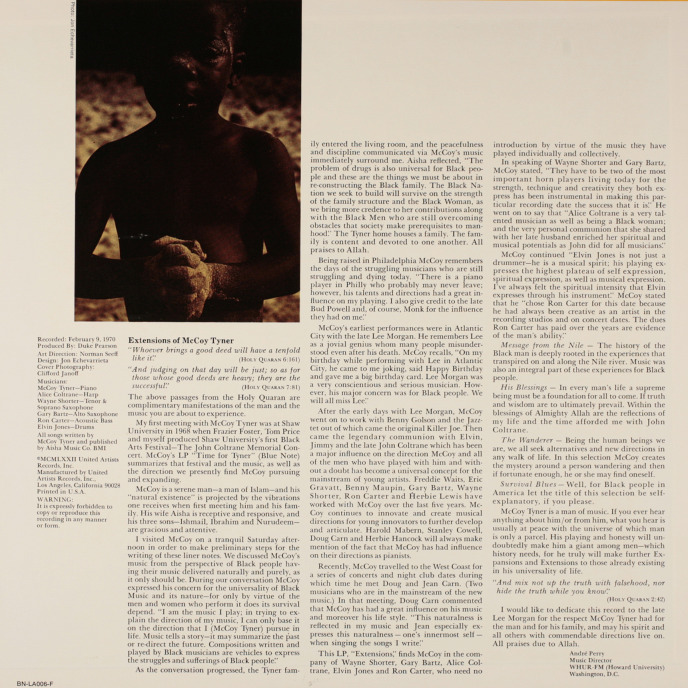
Extensions of McCOY TYNER

"Whoever brings a good deed will have a tenfold like it."
(HOLY QUARAN 6:161)

"And judging on that day will be just; so as for those whose good deeds are heavy; they are the successful."
(HOLY QUARAN 7:81)

The above passages from the Holy Koran are complimentary manifestations of the man and the music you are about to experience.

My first meeting with McCoy Tyner was at Shaw University in 1968 when Frazier Foster, Tom Price and myself produced Shaw University's first Black Arts Festival — The John Coltrane Memorial Concert. McCoy's LP "Time for Tyner" (Blue Note) summarizes that festival and the music, as well as the direction we presently find McCoy pursuing and expanding.

McCoy is a serene man — a man of Islam — and his "natural existence" is projected by the vibrations one receives when first meeting him and his family. His wife Aisha is receptive and responsive, and his three sons — Ishmael, Ibrahim and Nurudeem — are gracious and attentive.

I visited McCoy on a tranquil Saturday afternoon in order to make preliminary steps for the writing of these liner notes. We discussed McCoy's music from the perspective of Black people having their music delivered naturally and purely, as it only should be. During our conversation McCoy expressed his concern for the universality of Black Music and its nature — for only by virtue of the men and women who perform it does its survival depend. "I am the music I play; in trying to explain the direction of my music, I can only base it on the direction that I (McCoy Tyner) pursue in life. Music tells a story — it may summarize the past or re-direct the future. Compositions written and played by Black musicians are vehicles to express the struggles and sufferings of Black people."

As the conversation progressed, the Tyner family entered the living room, and the peacefulness and discipline communicated via McCoy's music immediately surrounded me. Aisha reflected, "The problem of drugs is also universal for Black people and these are the things we must be about in re-constructing the Black family. The Black Nation we seek to build will survive on the strength of the family structure and the Black Woman, as we bring more credence to her contributions along with the Black Men who are still overcoming obstacles that society makes prerequisites to manhood." The Tyner home houses a family. The family is content and devoted to one another. All praises to Allah.

Being raised in Philadelphia McCoy remembers the days of the struggling musicians who are still struggling and dying today. "There is a piano player in Philly who probably may never leave; however, his talents and directions had a great influence on my playing. I also give credit to the late Bud Powell and, of course, Monk for the influence they had on me."

McCoy's earliest performances were in Atlantic City with the late Lee Morgan. He remembers Lee as a jovial genius whom many people misunderstood even after his death. McCoy recalls, "On my birthday while performing with Lee in Atlantic City, he came to me joking, said Happy Birthday and gave me a big birthday card. Lee Morgan was a very conscientious and serious musician. However, his major concern was for Black people. We will all miss Lee."

After the early days with Lee Morgan, McCoy went on to work with Benny Golson and the Jazztet out of which came the original Killer Joe, then came the legendary communion with Elvin, Jimmy and the late John Coltrane which has been a major influence on the direction McCoy and all of the men who have played with him and without a doubt has become a universal concept for the mainstream of young artists. Freddie Waits, Eric Gravatt, Bennie Maupin, Gary Bartz, Wayne Shorter, Ron Carter and Herbie Lewis have worked with McCoy over the last five years. McCoy continues to innovate and create musical directions for young innovators to further develop and articulate. Harold Mabern, Stanley Cowell, Doug Carn and Herbie Hancock will always make mention of the fact that McCoy has had influence on their directions as pianists.

Recently, McCoy travelled to the West Coast for a series of concerts and night club dates during which time he met Doug and Jean Carn. (*Two musicians who are in the mainstream of the new music.) In that meeting, Doug Carn commented that McCoy has had a great influence on his music and moreover his life style. "This naturalness is reflected in my music and Jean especially expresses this naturalness—one's innermost self — when singing the songs I write."

This LP, "Extensions," finds McCoy in the company of Wayne Shorter, Gary Bartz, Alice Coltrane, Elvin Jones and Ron Carter, who need no introduction by virtue of the music they have played individually and collectively.

In speaking of Wayne Shorter and Garry Bartz, McCoy stated, "They have to be two of the most important horn players living today for the strength, technique and creativity they both express has been instrumental in making this particular recording date the success that it is." He went on to say that "Alice Coltrane is a very talented musician as well as being a Black woman; and the very personal communion that she shared with her late husband enriched her spiritual and musical potentials as John did for all musicians."

McCoy continued "Elvin Jones is not just a drummer—he is a musical spirit; his playing expresses the highest plateau of self expression, spiritual expression, as well as musical expression. I've always felt the spiritual intensity that Elvin expresses through his instrument." McCoy stated that he "chose Ron Carter for this date because he had always been creative as an artist in the recording studios and on concert dates. The dues Ron Carter has paid over the years are evidence of the man's ability."

Message from the Nile — The history of the Black man is deeply rooted in the experiences that transpired on and along the Nile river. Music was also an integral part of these experiences for Black people.

His Blessings — In every man's life a supreme being must be a foundation for all to come. If truth and wisdom are to ultimately prevail. Within the blessings of Almighty Allah are the reflections of my life and the time afforded me with John Coltrane.

The Wanderer — Being the human beings we are, we all seek alternatives and new directions in any walk of life. In this selection McCoy creates the mystery around a person wandering and then if fortunate enough, he or she may find oneself.

Survival Blues — Well, for Black people in America let the title of this selection be self-explanatory, if you please.

McCoy Tyner is a man of music. If you ever hear anything about him or from him, what you hear is usually at peace with the universe of which man is only a parcel. His playing and honesty will undoubtedly make him a giant among men, which history needs, for he truly will make further Expansions and Extensions to those already existing in his universality of life.

"And mix not up the truth with falsehood, nor hide the truth while you know."
(HOLY QUARAN 2:42)

I would like to dedicate this record to the late Lee Morgan for the respect McCoy Tyner had for the man and for his family, and may his spirit and all others with commendable directions live one All praises due to Allah.

—ANDRE PERRY 

BST 84419 (NR)

 McCoy Tyner - Extensions

Released - 1972

Recording and Session Information

Van Gelder Studio, Englewood Cliffs, NJ, February 9, 1970
Wayne Shorter, soprano, tenor sax; Gary Bartz, alto sax; Alice Coltrane, harp #2-4; McCoy Tyner, piano; Ron Carter, bass; Elvin Jones, drums.

tk.3 The Wanderer
tk.4 Message From The Nile
tk.5 His Blessings
tk.6 Survival Blues

Track Listing

Side One
TitleAuthorRecording Date
Message from the NileMcCoy TynerFebruary 9 1970
The WandererMcCoy TynerFebruary 9 1970
Side Two
Survival BluesMcCoy TynerFebruary 9 1970
His BlessingsMcCoy TynerFebruary 9 1970

Liner Notes

Extensions of McCOY TYNER

"Whoever brings a good deed will have a tenfold like it."
(HOLY QUARAN 6:161)

"And judging on that day will be just; so as for those whose good deeds are heavy; they are the successful."
(HOLY QUARAN 7:81)

The above passages from the Holy Koran are complimentary manifestations of the man and the music you are about to experience.

My first meeting with McCoy Tyner was at Shaw University in 1968 when Frazier Foster, Tom Price and myself produced Shaw University's first Black Arts Festival — The John Coltrane Memorial Concert. McCoy's LP "Time for Tyner" (Blue Note) summarizes that festival and the music, as well as the direction we presently find McCoy pursuing and expanding.

McCoy is a serene man — a man of Islam — and his "natural existence" is projected by the vibrations one receives when first meeting him and his family. His wife Aisha is receptive and responsive, and his three sons — Ishmael, Ibrahim and Nurudeem — are gracious and attentive.

I visited McCoy on a tranquil Saturday afternoon in order to make preliminary steps for the writing of these liner notes. We discussed McCoy's music from the perspective of Black people having their music delivered naturally and purely, as it only should be. During our conversation McCoy expressed his concern for the universality of Black Music and its nature — for only by virtue of the men and women who perform it does its survival depend. "I am the music I play; in trying to explain the direction of my music, I can only base it on the direction that I (McCoy Tyner) pursue in life. Music tells a story — it may summarize the past or re-direct the future. Compositions written and played by Black musicians are vehicles to express the struggles and sufferings of Black people."

As the conversation progressed, the Tyner family entered the living room, and the peacefulness and discipline communicated via McCoy's music immediately surrounded me. Aisha reflected, "The problem of drugs is also universal for Black people and these are the things we must be about in re-constructing the Black family. The Black Nation we seek to build will survive on the strength of the family structure and the Black Woman, as we bring more credence to her contributions along with the Black Men who are still overcoming obstacles that society makes prerequisites to manhood." The Tyner home houses a family. The family is content and devoted to one another. All praises to Allah.

Being raised in Philadelphia McCoy remembers the days of the struggling musicians who are still struggling and dying today. "There is a piano player in Philly who probably may never leave; however, his talents and directions had a great influence on my playing. I also give credit to the late Bud Powell and, of course, Monk for the influence they had on me."

McCoy's earliest performances were in Atlantic City with the late Lee Morgan. He remembers Lee as a jovial genius whom many people misunderstood even after his death. McCoy recalls, "On my birthday while performing with Lee in Atlantic City, he came to me joking, said Happy Birthday and gave me a big birthday card. Lee Morgan was a very conscientious and serious musician. However, his major concern was for Black people. We will all miss Lee."

After the early days with Lee Morgan, McCoy went on to work with Benny Golson and the Jazztet out of which came the original Killer Joe, then came the legendary communion with Elvin, Jimmy and the late John Coltrane which has been a major influence on the direction McCoy and all of the men who have played with him and without a doubt has become a universal concept for the mainstream of young artists. Freddie Waits, Eric Gravatt, Bennie Maupin, Gary Bartz, Wayne Shorter, Ron Carter and Herbie Lewis have worked with McCoy over the last five years. McCoy continues to innovate and create musical directions for young innovators to further develop and articulate. Harold Mabern, Stanley Cowell, Doug Carn and Herbie Hancock will always make mention of the fact that McCoy has had influence on their directions as pianists.

Recently, McCoy travelled to the West Coast for a series of concerts and night club dates during which time he met Doug and Jean Carn. (*Two musicians who are in the mainstream of the new music.) In that meeting, Doug Carn commented that McCoy has had a great influence on his music and moreover his life style. "This naturalness is reflected in my music and Jean especially expresses this naturalness—one's innermost self — when singing the songs I write."

This LP, "Extensions," finds McCoy in the company of Wayne Shorter, Gary Bartz, Alice Coltrane, Elvin Jones and Ron Carter, who need no introduction by virtue of the music they have played individually and collectively.

In speaking of Wayne Shorter and Garry Bartz, McCoy stated, "They have to be two of the most important horn players living today for the strength, technique and creativity they both express has been instrumental in making this particular recording date the success that it is." He went on to say that "Alice Coltrane is a very talented musician as well as being a Black woman; and the very personal communion that she shared with her late husband enriched her spiritual and musical potentials as John did for all musicians."

McCoy continued "Elvin Jones is not just a drummer—he is a musical spirit; his playing expresses the highest plateau of self expression, spiritual expression, as well as musical expression. I've always felt the spiritual intensity that Elvin expresses through his instrument." McCoy stated that he "chose Ron Carter for this date because he had always been creative as an artist in the recording studios and on concert dates. The dues Ron Carter has paid over the years are evidence of the man's ability."

Message from the Nile — The history of the Black man is deeply rooted in the experiences that transpired on and along the Nile river. Music was also an integral part of these experiences for Black people.

His Blessings — In every man's life a supreme being must be a foundation for all to come. If truth and wisdom are to ultimately prevail. Within the blessings of Almighty Allah are the reflections of my life and the time afforded me with John Coltrane.

The Wanderer — Being the human beings we are, we all seek alternatives and new directions in any walk of life. In this selection McCoy creates the mystery around a person wandering and then if fortunate enough, he or she may find oneself.

Survival Blues — Well, for Black people in America let the title of this selection be self-explanatory, if you please.

McCoy Tyner is a man of music. If you ever hear anything about him or from him, what you hear is usually at peace with the universe of which man is only a parcel. His playing and honesty will undoubtedly make him a giant among men, which history needs, for he truly will make further Expansions and Extensions to those already existing in his universality of life.

"And mix not up the truth with falsehood, nor hide the truth while you know."
(HOLY QUARAN 2:42)

I would like to dedicate this record to the late Lee Morgan for the respect McCoy Tyner had for the man and for his family, and may his spirit and all others with commendable directions live one All praises due to Allah.

—ANDRE PERRY

BST 84338

McCoy Tyner - Expansions

Released - June 1970

Recording and Session Information

Van Gelder Studio, Englewood Cliffs, NJ, August 23, 1968
Woody Shaw, trumpet; Gary Bartz, alto sax, wooden flute; Wayne Shorter, tenor sax, clarinet; McCoy Tyner, piano; Ron Carter, cello; Herbie Lewis, bass; Freddie Waits, drums.

3090 tk.1 Song Of Happiness
3091 tk.7 Vision
3092 tk.12 Peresina
3093 tk.21 Smitty's Place
3094 tk.27 I Thought I'd Let You Know

Track Listing

Side One
TitleAuthorRecording Date
VisionMcCoy TynerAugust 23 1968
Song of HappinessMcCoy TynerAugust 23 1968
Side Two
Smitty's PlaceMcCoy TynerAugust 23 1968
PeresinaMcCoy TynerAugust 23 1968
I Thought I'd Let You KnowCal MasseyAugust 23 1968

Liner Notes

What are some of the more profound and expansive qualities a discriminating layman generally searches for in a musician he favors? Could it be the artist’s mastery of his instrument or would the observer gravitate more towards how the artist develops his concepts as to make them original and stimulating?

McCoy Tyner is the kind of musician who gives the listener ample opportunity to avoid making the aforementioned choice. His musicianship and constant creation of stimulating concepts are so closely aligned that they have a tendency to envelop each other. This usually produces an effect of such emotion in his audiences that they view Tyner’s works as an entity, rather than attempt to break them down into their component parts.

A native of Philadelphia, Tyner began paying his dues at the age of thirteen. His early activities centered around the nightclubs and concert halls of his hometown: gigging with many of the local musicians. Tyner’s first major break came in 1959 when he joined a group called the Jazztet, formed by saxophonist Benny Golson and trumpeter Art Farmer. The six months he spent with the group enabled the young pianist to garner enough experience and musical where-with-all to join the legendary John Coltrane Quartet. The next six years of McCoy Tyner’s life were spent with “Trane” and his group touring all of the United States and Europe.

Currently, Tyner is composing and performing with his own group which has expanded in current years from a trio. quartet and quintet into a tentet. Among his future plans is to one day perform with the standard eighteen piece full orchestra.

McCoy Tyner’s numerous and dedicated followers are able to recognize his solos and compositions primarily because of the artist’s exceptionally unique style of playing and arranging. He is one of the very few musicians around today who can go through an entire set playing nothing but his own original tunes. This writer has witnessed such performances at Slugs and the Village Vanguard in New York, the Aqua Lounge in Philly, Wesleyan University in Connecticut among other places around the country. In addition to presenting his music for its entertainment value. Tyner has always expressed his desire to emphasize the cultural values and evolution of the music he has developed.

On Side A, VISION is an up-tempo composition based on an E flat minor scale. The focal point of this selection is the colorful piano interludes which include the basic rhythm section and unstructured cello support from Ron Carter. Subsequent solos by Wayne Shorter, Gary Bartz, Woody Shaw and Freddy Waits give eloquent testimony to each musician’s vast capabilities.

SONG OF HAPPINESS represents a composite interpretation of ideas and concepts gathered during McCoy’s voyage to the Far East in October 1967. The rhythmic pattern is basically a five tone Japanese scale with Gary and Wayne enhancing the Oriental flavor as they appear on wood flute and clarinet. According to McCoy. Overtones of serenity, peace and contemplation prevailed and the Japanese culture had a positive and lasting effect.”

On B Side, SMITTY’S PLACE is an up-tempo original that creates the euphoric sensation of perpetual motion. Playing duets simultaneously are McCoy and Wayne, Woody and Gary, Herbie and Ron and back again to McCoy, this time with Freddie. The second cut is PERESINA, a velvety three-quarter tempo original that reminds one of a Brazilian love song. McCoy plays introduction followed by a Wayne Shorter tenor solo and intermittent support from the entire ensemble. The album closes with a beautiful and melodic ballad by Calvin Massey called I THOUGHT I’D LET YOU KNOW. Again McCoy and Ron perform penetrating and relaxed solos on piano and cello to help round out a unique and totally rewarding musical experience.

THORNTON SMITH

75th Anniversary Reissue Liner Notes 

McCoy Tyner, who'd been on countless Blue Note sessions since 1960 beginning with Freddie Hubbard's debut "Open Sesame," signed with Blue Note as a leader in 1967 and began the relationship with the classic "The Real McCoy". By the next year, he would be touring with his own trio (Herbie Lewis and Freddie Waits) and when finances allowed, he would expand the group to a quintet with Woody Shaw and Gary Bartz.

Tyner had left John Coltrane's group at the beginning of 1966, but was having a tough time establishing himself as a bandleader. His association with Blue Note helped and with his fourth album for the label "Expansions", Tyner hit upon the sound that would inform all of his music as a bandleader. It was a blend of the rhythmic and melodic thrust of the classic Coltrane quartet with harmonic elements that were pure Tyner.

McCoy expanded his normal trio/quintet setting to include Wayne Shorter, who makes a rare recorded appearance on clarinet on "Song Of Happiness" and Ron Carter who is heard solely on cello. "Peresina" best defines the music that McCoy would compose and perform over the next few decades. It is a composition that he would return to a number of times in his career.

Michael Cuscuna


BST 84307

McCoy Tyner - Time for Tyner

Released - August 1969

Recording and Session Information

Van Gelder Studio, Englewood Cliffs, NJ, May 17, 1968
Bobby Hutcherson, vibes #1-4; McCoy Tyner, piano; Herbie Lewis, bass #1-5; Freddie Waits, drums #1-5.

3026 tk.2 Little Madimba
3027 tk.8 May Street
3028 tk.11 I Didn't Know What Time It Was
3029 tk.18 Afrika Village
3030 tk.20 The Surrey With The Fringe On Top
3031 tk.23 I've Grown Accustomed To Your Face

Track Listing

Side One
TitleAuthorRecording Date
African VillageMcCoy TynerMay 17 1968
Little MadimbaMcCoy TynerMay 17 1968
Side Two
May StreetMcCoy TynerMay 17 1968
I Didn't Know What Time It WasHart, RodgersMay 17 1968
The Surrey with the Fringe on TopHammerstein, RodgersMay 17 1968
I've Grown Accustomed to Her FaceLerner, LoeweMay 17 1968

Liner Notes

THE MEN arrived on the day of the concert. Raleigh was indifferent to their presence. The town was pre-occupied with its internal strife. All of these great men arriving at one time, and not one word in the daily papers. We had arrived a day earlier and were very familiar with local custom as it pertains to out-of-town "Blacks." From the moment we set foot on Raleigh soil it was very apparent that we were being watched. By the time we got to the motel it was obvious that we were persona non grata. White southerners have a way of affecting a very methodical and "accommodating" attitude whenever there are Black people they "have" to accommodate. I couldn't help but think about the early days (1959) of the "Sit-In" movement when the south was full of marches and demonstrations. It was hard to believe that this was America '69. Raleigh was alive with smoldering racial bitterness, policemen and I'm told FBI agents. On the evening of the concert, while this furious and dated collage of sight, sound and fury developed, Raleigh was to allow one of its few real chances for redemption, or at least understanding, pass almost without notice. Those of us inside the huge airy auditorium washed ourselves freely in the sound of hope and love created by Sonny Red and his men; the warm and holy waters of Yusef Lateef that lapped at our shores like gentle breakers along the Caribbean. McCoy and Freddie Waits sat in the Wings and listened intently to the Yusef Lateef Quartet. McCoy's trio had preceded Yusef's group on the program, and they had caused the audience to react from a region deep within. McCoy, his music, and the men he chooses to interpret his ideas always concert With the power and mastery of purpose of obeah.

The authority always emanates from McCoy, his musical environment is of such high calibre that wherever he takes it, there is always a quick and positive response. This man's music addresses itself to nerve ends, rather than the nervous system. that is why he can appeal to our emotional responses deep within. McCoy's presence made it a John Coltrane Memorial. Throughout McCoy's portion of the program one's ears could discern Trane's presence.

I learned some time ago not to try to recognize every tune McCoy plays during the course of a set or a concert. He possesses a wide range of original music, much of which is yet to be heard. We had all come to Raleigh at the invitation Of the brothers and sisters at Shaw University, to take part in their Black Arts Festival. It was really beautiful. As we moved about the large, clean lovely campus, there was an outpouring of easy kindness and warmth. This was such a natural setting for McCoy and his music. There's something about a college campus in spring, and on Shaw's campus where the overwhelming majority of the students are Black and are hard at work seeking truth through knowledge and its practical application, McCoy's music should be a ten credit course. I'm sure that if it were offered as such. no one would fail, mainly because of its relevance. Much of the music offered in those "music appreciation" courses are about as desired or appealing as a draft notice.

There is nothing sterile or mechanical about McCoy Tyner's music or his playing. McCoy has created his own musical vernacular and it is one that speaks on all levels. He eschews the cold technical, "'music for music's sake" approach for a more "real" and consequently more appealing type of development. In Africa, music is am integral and functioning part of everyday life. There are songs and dances for just about every occasion.

McCoy feels that music is a tool and should be used accordingly. Often, in the past, McCoy has reflected on aspects of his own life through his music. "Mode To John", "Man From Tanganyika", and "Blues on the Corner" are all songs that grew out of real life experiences for him. The years that McCoy spent with Trane were filled with love, truth, compassion, and learning. Those days are now very tender moments of his yesterdays. He recalls them with wistful and appropriate reverence. He speaks of many things, especially the affinity that existed among John, Elvin, Jimmy and himself. Weaker men would buckle over and spend a lifetime of regret after the passing Of such a monumental beacon in the darkness of our days. Weaker men would perhaps make the dreadful mistake of trying to "take up where John left Off," as it were. Few among us are able to know better than McCoy (Jimmy or Elvin) how futile (foolish) that could turn out to be.

McCoy Tyner has made his choice, and in view of the enormous ca city of the man, I say his choice has been correct. Which way could he go except his Own? Says he had to do it this way, in searching his broadly based and deep foundation for even more of himself, he is trying things. Make no mistake though, "trying things" does not mean idle experimentation. All of his yesterdays, todays and tomorrows are going into that search.

Each album bears the responsibility Of charting the chronology of his musical events and development. There is still a gap between each new release and the man. I guess it's impossible to determine his true apogee. Because his albums are not released in greater frequency, a musical bottleneck has developed. There was a time when one or two releases a year for an artist would be sufficient. In recent years though, the entire record industry has become embroiled in a kind of revolution of its own. For this reason, it has become necessary in most cases, to release albums on a more frequent basis. The heat of competition is intense in 'hot" or very "big" artists get the industry, consequently only very big artists get their music thrust into the inner circle. McCoy represents an area outside the "ring of fire" and his efforts simply do not receive the same type of urgent handling that many other artists do. Ironically. it's the artist outside the "ring of fire" Whose albums, for the most part, have the greater degree Of longevity. None of this excuses the fact that some artists should be heard from at more frequent intervals. McCoy and Wayne Shorter are the two candidates that I will nominate to get things started. (Blue Note, please note.)

Freddie Waits is one of the most beautiful souls I've met. He's honest, sincere, he has a Sense of humor and he is committed. You can hear a great part Of the same commitment in his playing. Freddie knows the importance of making a musical contribution whenever he plays. He swings freely from Johnny Hodges (with whom he recently and proudly recorded) to McCoy.

Herbie Lewis, is a paradox in that he too sounds so good, is so strong and seasoned on his instrument, yet his years belie his mastery. (The same is true for everyone on this date.) Herbie's commitment to life is manifest in his playing. I'm always impressed by his ability to "make sense" musically and verbally. Herbie Lewis can get long with anybody, anywhere, and he more than demonstrated that in Raleigh.

Bobby Hutcherson really does understand his instrument. He also loves it. Love and Understanding are the foundation on which this young brother creates. There is another very important aspect involved that is all too often overlooked. Bobby is not afraid to honestly acknowledge the "Reverend", Milt Jackson. Let's face it, if you're gonna play the vibes, you gotta go by Milt. Milt Jackson is the anchor man. Bobby is hip enough to appreciate Milt's prodigious contributions. He understands the history Of his instrument. In short, Bobby is a thinker, player, writer and innovator.

McCoy loves the vibes, he says he loves the sound Of the instrument. He has recorded with "Bags" and With Bobby. Little Madimba is about an African instrument found in the congo region. It is roughly similar to the xylophone in appearance. The Madimba, unlike the phone, has no metal parts in its construction. (McCoy has recorded on the Madimba.)

May Street and Blues on the Corner are related. McCoy was raised on what used to be May Street. (Urban renewal removed it.) African Village is, and Herbie, Freddie, Bobby and McCoy are living proof of that. They romp through it with all the spirit and fervor that one finds in an African Village. For the listener, they transform a state of mind into a statement of fact.

I once heard McCoy, Herbie and Freddie play Surrey at a concert and I've remembered the version till now. I really dig what they did with it here. They hijacked this Hammerstein-Rodgers vehicle With the fringe and steered it into new territory.

In his public appearances, McCoy usually does at least one solo piece. That is always very welcome. McCoy's approach to "standards" always bears a crisp lyrical freshness like the beads of dew on the petals of a rose at dawn.

I'm sure all who experienced the powers of McCoy in concert at Shaw University's John Coltrane Memorial will never forget the universality of the vast and bountiful world of the vast and beautiful bountiful world of McCoy Tyner. He plays healing music.

• Mode To John and Man from Tanganyika are from BST 84275
• Blues on the Corner is from BST 84264
• McCoy recorded with Bobby Hutcherson on BST 84244

ED WILLIAMS Maiden Voyage WLIB/FM
Civic Auditorium: Raleigh, N.C„ April 18, 1969

John Coltrane Memorial Concert
Shaw University's Black Arts Festival

PRODUCED BY DUKE PEARSON
Recording by RUDY VAN GELDER
Cover Photo by FRANK GAUNA
Recorded May 17, 1968

RVG CD Reissue Liner Notes

A NEW LOOK AT TIME FOR TYNER

"You never know what the situation will be," McCoy Tyner explained during a 1998 discussion about musical encounters with his peers. "Some ideas are good, some not so good." Since the occasion for our conversation was one of Tyner's periodic reunions with Bobby Hutcherson, it was clear that the idea of creating the partnership heard on the present recording (cut 30 years earlier) was very good indeed.

Hutcherson, who was also on hand when we spoke, got the collaboration rolling when he featured Tyner on the 1966 album Stick Up!, though as he noted his admiration for the pianist began even earlier. "I used to hear McCoy with John [Coltrane] at Birdland. In fact, I remember being there the night John hired Jimmy Garrison. When I finally started making sessions with him, McCoy probably recognized me as that guy in the audience."

"I knew who you were before then," Tyner corrected his friend. "I saw you playing with Gerald Wilson's big band in L.A., before you even came to New York."

Both musicians credited the fertile scene of the 1960s for nurturing their individual careers. "The whole environment was at one of its peaks, " the pianist stressed, "not just musically, but in literature and the theater, too. It was just normal then to look for new avenues...Every day you'd run into someone and say, 'Did you hear so-and-so?' or 'What are you writing?"'

"Everyone was exploring," Hutcherson concurred. "People who were waiting to get their cabaret cards would play in lofts, you could always find an after-hours session, and everyone was writing. It was just wonderful to be alive."

Such was the environment that produced Time for Tyner. As Ed Williams indicates in his original liner notes, it was a period of artistic and political struggle, of tragic losses, and newly discovered horizons. Tyner and Hutcherson were among the leading voices of the period, sharing a technical wizardry, harmonic and rhythmic sophistication, deep lyricism, and sense of proportion that made their partnership seem preordained. Their compatibility, so evident on these tracks, was instantaneous.

"Bobby's wife Rosemary has said that 'You two sound like one guy,"' Tyner noted, "and we do phrase together and know how to complement each other." Hutcherson added, "We don't make adjustments when we play together. For my part, I just let myself be swept away."

The approach has worked frequently over a span of nearly four decades, but never better than on this album, where Hutcherson was added to Tyner's working trio of the period. The program is similar to the music they have served up since then in its mix of original compositions and standards. Tyner's tunes and "I Didn't Know What Time It Was" are by the full quartet; "Surrey" is a trio track and "I've Grown Accustomed to Her Face" a piano solo. While Tyner's three outstanding contributions have rarely been heard in subsequent years, they have not been forgotten, and by coincidence the pair performed "May Street" on the evening of our conversation. "I Didn't Know What Time It Was" is the lone title to have reappeared in either man's discography. Tyner returned to it in duo with Stéphane Grappelli in 1980 and with his then-new trio in 1985.

Tyner and Hutcherson, in contrast, have managed to reunite in the recording studio quite frequently, generally under the pianist's name. Several of these ventures have reprised the quartet format heard here — Tyner's 4x4 (1980) and Land of Giants (2002) and Hutcherson's So/o/Quartet (1982) — but the pianist has also included Hutcherson on the larger ensemble projects Sama Layuca (1974), Together (1978), and La Leyenda de la Hora (1982). As co-leaders, they recorded the beautiful duo album Manhattan Moods for Blue Note in 1993.

Credit is also due Herbie Lewis and Freddie Waits for their contribution to the present music. Lewis, who also appears on Stick Up! and So/o/Quartet, was an associate of the vibist's since their California days (they first recorded together with Les McCann in 1960) and was a member of the quintet Hutcherson led with Harold Land. Waits, who died in 1988, may currently be best known as the father of drummer Nasheet Waits but was an inspired accompanist throughout his own career. Lewis and Waits were Tyner's rhythm section of choice in the late-'60s, and can also be heard in support of the pianist on Tyner's Blue Note albums Expansions and Cosmos.

— Bob Blumenthal, 2005